00;00;08;20 - 00;00;31;05
Unknown
Hello and welcome to The premise. I'm Jennifer Thompson and I'm Chad Thompson, and today we are here with Stephen Kiernan who is a fantastic author, but also just really an amazing guy. And I hope listener, you get to know him a little bit during this conversation. I've been following him for a couple of years now, and so this is a real honor to have Stephen on the premise.
00;00;31;05 - 00;00;55;11
Unknown
So let's tell you a little bit about him. Stephen P Kiernan is the author of the novels The Curiosity, The Hummingbird, The Baker's Secret, Universe of Two, and The Glass Chateau. A graduate of Middlebury College, John Hopkins University, and the University of Iowa Writers Workshop, he spent more than 20 years as a journalist, winning many awards before turning to fiction writing.
00;00;55;11 - 00;01;22;24
Unknown
He has also worked nationwide on improving end of life medical care through greater use of hospice. Kiernan lives in Vermont, where I'm guessing it's quite chilly. Yes, yes it is today. Always it is until June or so, right. But really beautiful. So there's that. Yes, I love it here. I've been here a long time. Nice. Well, so today we are going to talk about your forthcoming book.
00;01;22;25 - 00;01;48;29
Unknown
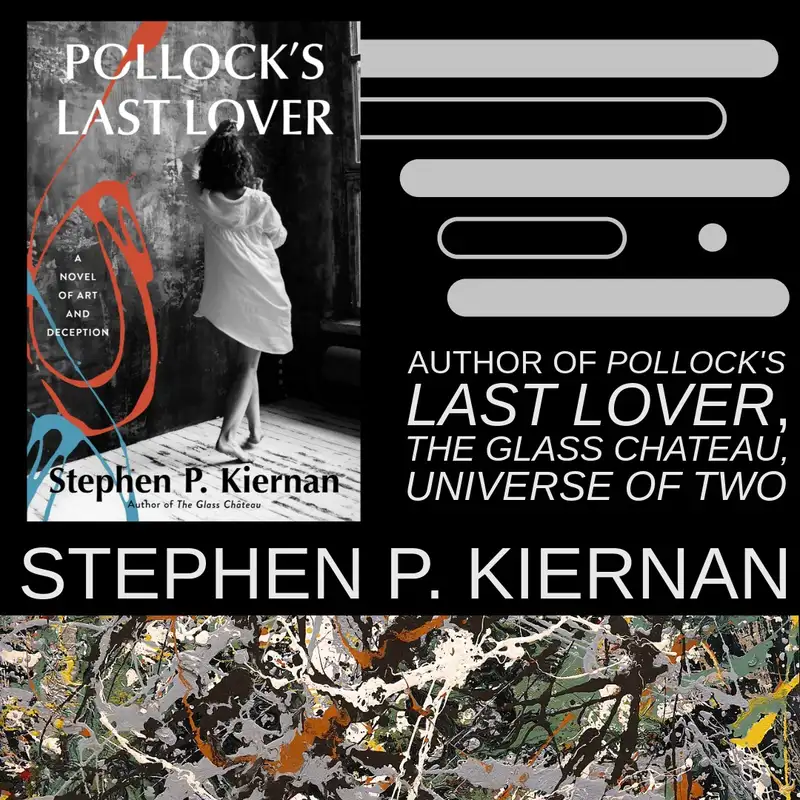
It's coming out May 19th. Pollock's Last Lover A novel of Art and deception. This was a really good book, and what I found kind of fascinating about it, Steven is at the end of it. It really wasn't that much about Pollock as it was about the women in his life. Can you tell us a little bit about this book, Pollock's Last Lover, and what it meant for you to write it?
00;01;49;02 - 00;02;08;22
Unknown
Well, first, can I just say, like, how you just made my day? Yeah, because there have been very, very few. I mean, really, there have been very few readers so far. The book's not available. So it's when it's, you know, provided to the media before, before interviews and that sort of thing. And you got exactly the point, which is that that Pollock is, is central to this book.
00;02;08;22 - 00;02;29;15
Unknown
But he's not the main character. He's probably about fourth. Yeah, maybe fifth. And it is really about the women around him in two different periods of time, and one when he's alive and one when he's not. And and I had tried years ago to write a book about Pollock's, the last section of his life. And it was really dark and very depressing.
00;02;29;15 - 00;02;52;10
Unknown
And when and this isn't now, I think, at all, it's was much more interesting to me to learn about his wife and his lover and the people who are dealing with his works later on in subsequent generations. And it becomes it became sort of an examination of, of the roles of women and how women have power in 1956 compared with contemporary times.
00;02;52;12 - 00;03;21;03
Unknown
Yeah. So so the quick plot summary is this, you know, in Jackson Pollock, right? Considered the greatest painter in America in the early 1950s, late 1940s, died in 1956. And 50 years later, one of his paintings sold at auction for $140 million, the most ever paid for work of art at the time. And and about three weeks later, this woman came forward and said, hey, I was his sweetheart.
00;03;21;03 - 00;03;35;29
Unknown
At the end of his life. I was his lover, and he made his last painting for me, and I've been keeping it in my apartment in the West Village in New York City all these years. And I realized the world needs to see his works. So I want to bring it out to the world so that everyone can see it.
00;03;35;29 - 00;03;57;24
Unknown
And and the bidding will start at $50 million. And then you have the story of a young woman who's very ambitious in this auction company trying to authenticate the painting. And so the two different women and their relationship with Pollock and their relationship with power, and how they think women succeed and support each other or don't. And, yeah, they had a lot of fun with it.
00;03;57;26 - 00;04;20;06
Unknown
A lot of discovery, I bet, I bet. And it was it was fun reading it. And I also thought it was really interesting because, you know, we're looking at these women and their lives and how the times affect what they're capable of or what they're allowed to do, I should say, and what they think they're capable of. And being written from the perspective of a man I thought was very interesting.
00;04;20;08 - 00;04;42;12
Unknown
Well, it meant that I was very careful, and I spent a lot of time running this by female readers of All Through It. And, you know, there's a scene early on in the book, for example, where a young woman who is not very experienced as a model has a photographer say at the end of a catalog shoot, he says, hey, I'll shoot some new headshots for you if you like, for free.
00;04;42;12 - 00;04;59;20
Unknown
And she says, sure, great. And everyone leaves. And now she's alone with this guy and he's photographing her, and he's asking you to be in suggestive poses. And when she resists, he says, you're never, you know, you're never going to have a career in this if you're going to be, you know, a diva all the time, all of this sexual harassment pressure.
00;04;59;20 - 00;05;19;12
Unknown
And, you know, I went around to my nieces, for example, some of my nieces, and I'd say, is this is this realistic at all? And they would say 100% all young women have experienced it all. And so that was really sobering for me. I thought it was, you know, apportion because there are some jerks, but it turns out it's still now even common behavior.
00;05;19;13 - 00;05;40;23
Unknown
And yeah, so, so great. So that just made me feel like I need to be that much more careful. And my editors female, the marketing person on my of my book, the, the, the publicist, my agent, I mean, it's all it's women. Oh, the publisher is a woman. And so I count on all of them. They're all strong women.
00;05;40;24 - 00;06;04;01
Unknown
They would not be shy in the least about setting me straight on, on things. And so I depended on that. And then I took what risks I thought I could get away with. Well, and let's talk about these two female characters. So we've got Ruth Kligman and it's, you know, 1950s, 1956. And in present time we've got Gwen.
00;06;04;01 - 00;06;31;05
Unknown
So it's 2006 and they're both very strong women. They're very strong characters who are really trying to make it in the same way, you know, interested in their own power. And, you know, in that scene when Ruth is in getting her headshots done, she says no to a lot of things. You know, she's aware of the fact that this might get me somewhere, but I know that this is not I can't say yes.
00;06;31;05 - 00;06;53;18
Unknown
And so many women say yes because they think they don't have a choice. But but Ruth, she had some spa, didn't she? A little bit. She did. Yes. And it was actually this is just almost embarrassing to say. But there was a thing I remember being in like eighth grade or so, and that summer, one of my friends would go up to girls and say, can you touch your elbows behind your back?
00;06;53;21 - 00;07;12;19
Unknown
That was a thing. I would never try it. Of course, it was a way of displaying their breasts. And just like, even though I was 13, I still am embarrassed, you know? But but then to put that moment in, in this photographer who's an adult photographing a woman who's a young adult, but she's an adult also, and she's like, no.
00;07;12;20 - 00;07;30;07
Unknown
When he says that, he says, bring your elbows back. She's like, no, I went to high school, you know? And so so she's not and she's so she does she does have some power. And in fact, she ends up, I don't know, in a way she ends up ending this guy career, this guy's career. Later in the book, almost in an offhand way.
00;07;30;14 - 00;08;02;18
Unknown
And and and so she does definitely have power. It does depend on her sexuality. And, you know, she's not above flirtations that go much further with certain men if they're in the arts and a kind of status way very different from the woman in 2006. But she has her way. And in fact, she ends up having, you know, she's she's based on an actual person, the, the, the lover that Pollock had in the last four months of his life.
00;08;02;18 - 00;08;23;08
Unknown
And she ended up being, you know, hanging out with Andy Warhol and being photographed by Robert Mapplethorpe and being very much like the hip New York City art world, even though which he'd been, at least at the start, was just was a girlfriend, somebody's girlfriend, extracurricular extramarital. Well, girlfriend. And she shows up in New York. She's totally green.
00;08;23;08 - 00;08;51;27
Unknown
I forget where she's from, but, you know, some Midwest farm town or something like that. And, you know, she shows up with her suitcase and she's green, and she learns real fast that she does have power in her sex appeal. And she uses that. In fact, she enjoys it. There's a scene where there's these construction boys, and she's on her way to work, and they all, like, whistle and hoot and holler and, you know, and she kind of like, sways and, you know, she, she gets her her strut on because she realizes, you betcha.
00;08;51;27 - 00;09;14;13
Unknown
Baby, I've got power. Look at me. That's exactly yes. Yes. And please, no, I was just going to say and then, you know, fast forward to Ruth is an, you know, an older woman. Now we're in 2006, and Gwen is the young woman who has zero interest in her sex appeal, who really just wants to use her brain, be successful, be taken seriously.
00;09;14;13 - 00;09;39;06
Unknown
And Ruth says to her in a conversation they're having, you're too young. Ruth waved up and down at Gwen. You have no inkling of the future. No grief for a body that will not last. What your current body makes possible for you, what power there is purely in your physical self. And it's almost like she's admonishing Gwen, like it's gonna it's going to go away.
00;09;39;09 - 00;10;03;21
Unknown
Be prepared. Yes. Right. Yes, yes. They they actually I mean, they do not get along well because they have such different ideas. Right? For Ruth it is about her sex appeal. It is about her way of calculating. She has a maybe we're talking a minute about minor characters, but her roommate is educating her about the ways of New York in 1956, a ways that are comical but also correct.
00;10;03;22 - 00;10;21;18
Unknown
Lucy. Lucy. And. But meanwhile. Meanwhile, you know Gwen in 2006, like one of it was, you know, it's fun to go back and look, I don't think of 2006 as historic, but when I went back and look, first of all, it was not a good year for popular music. I always like to have music playing in the background of scenes.
00;10;21;19 - 00;10;50;05
Unknown
And there's a, there's a, there's like a disco scene in the music is awful. But but on the other hand, she is the first person in her workplace and among her friendships to have purchased one of these crazy new devices, the iPhone. Right? Yeah, that was cool. And like and it has very, not very sophisticated MapQuest to get you around and, and New York is just starting to turn away from the grieving of nine over 11.
00;10;50;06 - 00;11;13;01
Unknown
Yeah. And they go down they go down there and and so and she, she has many more friends than Ruth does. And so they have different ways of, of work. And so they very much it's all in vinegar. They do not mix well when they're in scenes with each other. And, and there are ways are trying to prove that this painting is legitimate.
00;11;13;02 - 00;11;40;11
Unknown
It's worth a lot of money to both women. If this painting is that she's come forward with is legitimate, it's authentic. And so so they have the same the same goal. But their different styles make for all kinds of friction that I think is sort of looking at. We have enormous distance still to travel in, in the respect for women in this culture, in this country.
00;11;40;11 - 00;12;10;28
Unknown
And yet there has also been enormous progress since 1956. And so that's, that's that's part of the story too. Well, and, you know, I also really enjoyed the juxtaposition of, you know, Jackson and Ruth in 1956 and Gwen and Arthur in 2006. Because, you know, Jackson and Ruth, their lovemaking is rough. It's almost angry. You know, he takes what he needs from her, and then that's it.
00;12;11;00 - 00;12;31;16
Unknown
So she gets something totally different from him. And then with Gwen and Arthur, we have this tenderness where he. All he wants to do is take care of her and and give to her and, you know, provide her with not just intimacy, but, you know, really make sure she's taken care of. And their relationships are so often so opposite.
00;12;31;16 - 00;12;48;07
Unknown
I wonder, was that on purpose or did that just sort of happen as you were writing? Well, you know, it's I should say, first of all, you know, this is this is my eighth book and it's the first one that has any sex in it, really. There's like hints of sex in my books, but. And this one has a lot of sex in it.
00;12;48;08 - 00;13;12;18
Unknown
Yeah. And when I told the marketing director it was a good friend of mine. We become great friends over the years. And when I said that that this one was pretty saucy, she said, well, it's about time. So I guess I've been holding back and I didn't know. And but in fact, the power that these women have in relationships is reflected in their sexuality and in the kind of love making that they do.
00;13;12;19 - 00;13;34;10
Unknown
And as you said, with with Jackson, it's pretty rough business. It's not, you know, it's not very generous and it's not very gentle. And whereas with with Arthur, who's, you know, again, for Gwen, it's like it's a terrible mistake because it's a workplace romance and she's trying to be the woman of the 21st century. How could she pursue this relationship?
00;13;34;10 - 00;13;59;22
Unknown
Except that he's a great lover and he's, you know, really sexy, and he's British and kind of charming and humble, and and when he wants to make a point, he does it like he's driving a nail. It's so strong and clear and so. So, you know, the contrast to relationships. I don't want to overload it and say all sex was bad in 56 and all sex is great in 2006.
00;13;59;22 - 00;14;25;09
Unknown
I'm sure there were plenty of good and plenty of bad in both times, but it is. It is more to to talk about how they are in relationship, how they are in intimacy, and to what extent they are subservient or are have like the dominating role and and how that plays out in their relationships and, and that their lovemaking is congruent with that.
00;14;25;12 - 00;14;53;08
Unknown
Very well done. Yeah. Thank you. Let's talk about when did you decide you wanted or when did you know you were going to write this book, like what happened for you and the rabbit hole you fell into? Because I know you must have fallen into 101 hundred miles deep. Okay. It's I wish it was this great inspired story, but the reality is I'm going to say, oh, I don't know, eight years ago, nine years.
00;14;53;11 - 00;15;13;06
Unknown
I just heard about, like, the last couple of months of Jackson Pollock's life. And I thought, that is compelling, even though it's really dark. And so I started reading. There's some great biographies, one particular on him, and there's a great biography of his wife and on their great books about the artists of that time and abstract expressionism. I didn't even know what it meant.
00;15;13;06 - 00;15;44;10
Unknown
And it was it was a great little rabbit hole. And I said, this is a book. And I got about 180 pages in, and I said, no, this is the most depressing thing I've ever read, much less written. It is like like Jude the Obscure. It's just not good. And so so I put it aside and I wrote The Baker Secret, which actually been the best done the best of any of my books and, and but, but then when I finished the last book, The Glass Chateau, I had conversations with my editor, Jennifer Burrell.
00;15;44;10 - 00;16;03;17
Unknown
She's terrific. I really trust her judgment a lot. And we've now worked together for, I don't know, 15 years or something, you know, across across six books. And so, so she said, well, what about that Jackson Pollock book? And I said, well, the problem is so dark. And she said, and she does not normally make me write a formal proposal.
00;16;03;17 - 00;16;24;29
Unknown
And she wanted one for this one. She said, make, make a formal proposal for the story you want to tell. It was such a great suggestion, pain in the neck in terms of the time it required. But it made me go back and say, what is the real story here? And it made me realize it is not a passionate artist who's got mental health issues and substance abuse issues and his genius.
00;16;24;29 - 00;16;50;12
Unknown
And what results from that, that story has been told and that that the unique thing was the women around him, you know, his wife, who plenty, plenty of people will say is a superior artist to him, certainly certainly very strong on her own and who Ruth was. She wrote a memoir that is unreadable, saccharine. But but I read it because I had to say, oh, it's painful, painful.
00;16;50;16 - 00;17;12;02
Unknown
And I really felt like I was doing the reader a favor. Like, you don't need to go read her anyway, and then to think about what New York was like in 2006 and how the roles have been have changed. And and suddenly that became the fascination for me. And it felt like I was learning. It was different kind of research to go to go to my niece and my nieces and say, have you been hassled this way?
00;17;12;02 - 00;17;39;23
Unknown
And they're like, only every time I get on the elevator. Yeah. You know, that's that's a very sobering thing to hear, you know, and, and one of my early writers is a very successful novelist and friend. And when she read the first part of it and said, you got to go way, way further, you know, she said, you say like that, that, that she thought he was his muse when actually she was a siren pulling Jack, luring Jackson onto the onto the rocks.
00;17;39;23 - 00;18;27;12
Unknown
And both Muse and Siren are male constructs, right? Yeah. You're like, oh yeah, yeah, I need to rewrite everything now. And so it was much more. And so, so there was much more discovery for me in that. And I guess the last thing I'd say is I still don't exactly know what Abstract Expressionism is, but I know that some of it is spectacular, is incredibly saying things that cannot be said in any other way, and that Pollock was because he was mentally unstable and because he was self-medicating with alcohol and just general decadence that that when he was able enough to work, he would go to a place that that, you know, no one else
00;18;27;12 - 00;18;46;24
Unknown
has really been able to do. And that's that to me that that made it so. So all these years later, in between, I wrote, I wrote, so I wrote The Glass, The Baker Secret, and then I wrote Universe of Two, and then I wrote The Glass Chateau, and then I went back to trying this again. So I don't know, like, yeah, and I've not done that before where I went back and I threw away every word.
00;18;46;25 - 00;19;09;24
Unknown
I looked at 180 pages. I had like, it's going to be great. I going to get a first draft in no time. It was all, it all had to go, wow, I had to start right from beginning again. Yeah. And how you depict him as an artist, I presume, is all true, like the research you found when he would create a piece and we're talking, like 24ft long, these massive canvases, he would do it.
00;19;09;25 - 00;19;48;03
Unknown
He wouldn't sketch anything out in advance. It was like his brain was just creating this entire piece all at once. Yes and no. I mean, here's the thing, Jennifer. He he couldn't draw. I mean, he spent he spent years at the art students organization and trying to learn how to draw. And he never really got it. And you can look at his, at other painters of that time, and you look like a still life that they did, even if what they did, as art as their paintings were totally bizarre and abstract there, their drawings looked like what they were drawing at very high level.
00;19;48;03 - 00;20;19;06
Unknown
And he couldn't do that. And so he had to conceive of the work in his head, and that was hard to do. And so the way I describe it in the book is, let's say you were going to you're going to make a cardboard sign that said for sale refrigerator. You know, if you just if you're not artistic, you're going to get to about refrigerator and you're going to be running out of space for all those extra letters, you know, and somehow he knew intuitively exactly how large the letter should be so that it would fit perfectly.
00;20;19;06 - 00;20;48;04
Unknown
And that's super reductive. But it is a way that he understood the space of canvas in a unique way. And the other thing I'll say, it's kind of fun. You know, I spent a lot, a lot of time at his home in Springs on Long Island, but I also spent spent hours and hours and hours in his studio, and the floor of that studio changed my opinion of him to see this fills and and and I don't want to say anything about you.
00;20;48;04 - 00;21;06;03
Unknown
You've read this, you know, there's a scene, a very short moment in the book, but for me, it's the most heartfelt moment in the book is where the character is enacting what I found when I saw it, which is I won't give it away. But but the reason that his biggest paintings were 22ft is because his studio was 22ft wide.
00;21;06;04 - 00;21;26;09
Unknown
Yeah, yeah, just, you know, so. So he'd put it on the diagonal so he could step around it because the canvas is on the floor. If you're using, you know, latex paint, it will run. You can't put it on an easel. So it's got to be on the floor. And so if he like his, if his studio had been four feet bigger in each dimension, he'd have 26ft paintings.
00;21;26;09 - 00;21;50;23
Unknown
He was like, literally the only can you think about the freedom of his imagination, but also the walls of his room? Okay, so I have two questions and I'm going to tell you what they are so I don't forget. One, I want to talk about Peggy Guggenheim in her piece, because I want to know if that's true. But before we go there, I want to know what it's like as a writer when you go into a space like that and you just told us you spent a lot of time there, what is that?
00;21;50;25 - 00;22;03;23
Unknown
What does that look like? Like just sitting there, like trying to soak it in and contemplate. You just sit in silence, like, bring us into your brain in that moment. In those moments.
00;22;03;25 - 00;22;29;17
Unknown
Oh, boy. Okay, so. So I guess I should say that The Glass Chateau, which is my most recent novel all through it, it's a story about men. It starts right after the end of World War Two, and it's men who rebuild their lives by building stained glass windows for the cathedrals that have been bombed out during the war, and the windows that they used, that I had them build were the windows that Marc Chagall built.
00;22;29;17 - 00;22;52;19
Unknown
And Marc Chagall is a really a lovely artist. And I immersed in his life and in his work, and it was very fun. You know, his his stuff is like it's folk art and it's also surrealism, and somehow it's both in a very unthreatening, really fun loving way. And so I thought, you know, that would be so cool to do with Jackson Pollock.
00;22;52;19 - 00;23;22;14
Unknown
Whoa, what an error. What an underestimating of the madness and the genius. And it was a very different experience. And there were times when I was writing this book, I was like, I don't like this guy. Yeah, but don't like this guy. Yeah. And, you know, and because he had such gifts, but he'd also come from so much anguish and, and and then he was, you know, using this, this lover and and so, so I forget what the question was.
00;23;22;17 - 00;23;52;11
Unknown
What's it like? So the thing is, if you look at, if you ask your listeners to just open up, you know, their, their search engine and just put in a Pollock painting, whatever comes up is not going to be like the, the, the scene that you understand in an instance where if you look at, you know, even a Van Gogh, maybe it takes a couple of minutes, but you see, at least the whole thing, you get a pretty good idea if this is a starry night.
00;23;52;11 - 00;24;15;25
Unknown
And these are like how the imagination of the artist made the stars do this in the sky. And I can tell it's the sky and trees and ground, okay. And and so the reading of it takes seconds. And I have spent hours sitting in front of Pollock paintings, finding more things. Wow. Finally seen it saying, oh, it's these are the six poles.
00;24;15;25 - 00;24;40;20
Unknown
Okay. The blue poles. And that's very interesting. And I know the story of that. But but look at what he did there. And it's different here and it's different here. And in fact it's like a sequence across from left to right in this painting. And you know, and the thing is gigantic. And so there's just, you know, I never had the experience of sitting in like walking along a painting, reading it, you know, it's it's it's a really different thing.
00;24;40;20 - 00;24;59;13
Unknown
And, and I realized that's what I didn't like I'd gotten so that when I look at a painting, it's like, well, there it is. Says on very nice. Look, there's, you know, there's there's right there's my knees garden. Yup. Bridge over the garden, just like I imagined it, you know. And you can look at the detail in it and there's genius and expression in it.
00;24;59;13 - 00;25;25;05
Unknown
But somehow with Pollock, because it was abstract, because it wasn't a bridge over a pond, it was circles of fire that looked like they are dancing and and you and and and somehow he fitted all in. He made the refrigerator of these dancing characters fit perfectly and without measuring it, just because he had a concept of space that good interesting and that that keen.
00;25;25;08 - 00;25;54;24
Unknown
Right. And so I found myself interested. And then I started spending more time, and suddenly I would find that I'd spent 90 minutes looking at one painting. Wow. Where? Okay. Where were you when you saw Jackson Pollock? In real life? You know, I've bounced around, but, you know, New York City primarily. So there is, in fact, a show coming up in New York City this fall where they're going to have the works of Jackson Pollock and his wife, Lee Krasner, in equal numbers.
00;25;54;26 - 00;26;12;09
Unknown
So it should be treated as an equal for the first time. Yeah. Because she really was that kept him kept him afloat. I want to go. Are you going to go? Of course you are. Oh, yeah. Absolutely. Yeah. Yeah, I can totally see you doing a book signing or some sort of an event. I don't know if they'd let you, but that would be cool.
00;26;12;11 - 00;26;28;06
Unknown
It would be cool. You know, they there there are lots of books about Jackson Pollock, but there actually aren't novels about him. Okay, that makes you seem to find that when I did my homework. So I think that they should, you know, I think that they should make me part of the show, and I didn't really. Who knows?
00;26;28;06 - 00;26;53;03
Unknown
But you know that I agree. I will write them a letter and I'll let them know. Please have. Thank you so much, Stephen P cannon. There are no literary coattails being grabbed here. No, I think, you know, I hope I'll do some speaking about that in various places. And, and I mainly I'm looking forward to seeing it because, you know, a lot of years have gone by and I just wonder if the world is ready for him yet.
00;26;53;05 - 00;27;21;29
Unknown
And we'll see what kind of shape American culture is in when October comes around, and see if this is something that we appreciate or reject. Right. And things are changing so rapidly here. It's could go either way, I think. Yes. Let's go back to Peggy. So he she commissioned a piece and it was too long and they had to make some adjustments, which I can have you talk about, but is that a true story?
00;27;22;01 - 00;27;43;13
Unknown
Mural is a true story. And it's actually the first Pollock painting I ever saw because it was in the in the gallery, the museum in Iowa City, Iowa. And I went to graduate school there in the Writer's Workshop. So I actually saw my first Pollock. Oh, I don't know, almost, almost 40 years. No, it can't be. That's cool.
00;27;43;15 - 00;28;05;13
Unknown
A lot is a lot of years before before writing this book. So, yeah, she commissioned a painting that was to fit a wall in her apartment, and she had done a show for him, and it had not he had not fared well. He hadn't sold much work, and the critics had not really loved it so much. And and she thought they were missing the boat.
00;28;05;14 - 00;28;37;23
Unknown
And so she thought, well, one showy thing would be to have a party and have this and have this painting on the wall, a long wall of her apartment. And, and basically Jackson Pollock did the most agonizing. I don't I don't want to take it away from the book, but the most agonizing kind of voiding this job and delaying and delaying and staring for days on end, the blank canvas and and then 24 hours before it absolutely had to be done.
00;28;37;24 - 00;28;54;14
Unknown
And she also, by the way, she was helping him another galleries she was perhaps there are signs that he was she was paying part of his mortgage and she was keeping his guy afloat for a while. She paid him a monthly fee and whatever he painted, she got like she really was invested in him like no other artist.
00;28;54;14 - 00;29;19;04
Unknown
And so he made the painting and this great and this great binge and then and then had to roll it up before it was all the way dry, and they put it up and it didn't fit the wall. And I would give up what happens there. But I would just say it is a matter of historical fact that that he was getting drunk while the painting was getting while the party was taking over and and when when things went awry, he just went and peed in the fireplace.
00;29;19;06 - 00;29;42;12
Unknown
Yeah. And and that's that's true story. He did pee in the fireplace. I wouldn't have made that up. Well, well, let's talk about what you made up. And, you know, as a historical fiction writer, talk to us about how much leeway you have to change facts and move things around to fit your story, but still fit within the nicely.
00;29;42;14 - 00;30;05;21
Unknown
This is this is a thing I've struggled with and worked with in a lot of my books. You know, the Baker Secret starts out 24 hours before the first men come ashore in the evasion of D-Day and D-Day, told from the French perspective. And there are so many buffs and fans and students of D-Day. That boy, I did not play with that at all.
00;30;05;21 - 00;30;24;17
Unknown
I was very much. And I took one liberty and I heard from readers and it was it was a thing that actually occurred, but I made it actually occur earlier. And they were offended by that. And I kind of hear their point. And then University of Two is a love story set amid the Los Alamos in 1944, when they're building the atomic bomb.
00;30;24;17 - 00;30;49;12
Unknown
And again, there were certain things I had to obey. So in this case, especially the 1956 part, things happened at a certain rate. And so all of that had to, had to follow when he, when when Jackson and Ruth meet, when they first make love, when she goes out to Long Island to be near him and all the things that happened with them and all has to line up with the reality.
00;30;49;12 - 00;31;09;08
Unknown
And in New York City, you know, Second Avenue never goes uptown. It's a road going down. Right? So there's all of this stuff that you have to have, right? They can't have too much Duke Ellington playing because really his recordings time was after 56 things like that. But then but then each then there are two kinds of invention.
00;31;09;08 - 00;31;30;07
Unknown
One is every scene has to take place someplace. And so I have liberty with that. And I have a lot of fun with that. There are ways that this book is a little bit of a love letter to New York City. And so, yeah, you know, and how people get around and where they have their conversations, where they kiss for the first time, all of those things sort of in settings that exist.
00;31;30;10 - 00;31;51;05
Unknown
You know, my first two books are published by Saint Martin's, and that was and they were in the Flatiron Building. And across the street there was this diner that said, you know, clogging people's veins and giving heart disease since 1946. And and I considered it my good luck place. And I would go there for like for a cup of coffee before going in for meetings.
00;31;51;07 - 00;32;07;07
Unknown
You know, it was my first books and I was so, so nervous. So I put that I put that place that that diner in the novel. Yeah. Just straight out of reality. Okay. And so I really held to that. But then I could, I could fool around with other things and, and and then I took some, some liberties.
00;32;07;07 - 00;32;33;09
Unknown
I, for example, put two of Lee Krasner paintings next to each other in the Whitney Museum in New York, and both paintings have been in the Whitney at some time, but not at the same time. So that's like a minor that's like, okay, I'm making I'm bending reality a little bit just for the sake of the story. There are there are a couple of characters in this novel who actually serve the roles that three people did, like Lucy, we talked about before.
00;32;33;10 - 00;32;59;03
Unknown
Lucy was actually kind of it was a consolidation of three people in in Ruth's life. And but the and then really pretty much holds to reality, except for one thing, Leake, Lee Krasner. I keep Lee Krasner alive. Yeah. Years beyond when she actually lived. And I know that that is a leap and that there will be experts and scholars of Pollock.
00;32;59;08 - 00;33;29;14
Unknown
You're going to get some letters. Yeah, I want those letters. Because what she says, the result is that she gets the last word. And I think her last word is is the definite. It's like the judges gavel bang. And and so I'm willing to to fictionalize her and use poetic license however you want to describe it, to keep her alive eight years longer than she actually lived, so that she can say what she believed and what in fact, her behavior showed in years after Jackson died.
00;33;29;21 - 00;33;50;29
Unknown
So there's a whole range in there. And what I feel like, the way I redeemed my soul and I don't burn in hell forever about it, is in the acknowledgments at the end, I will say these parts are real. These parts are not real. This person was actually a couple of people I don't like. I don't go on for every little thing that I invented, but I do.
00;33;50;29 - 00;34;14;24
Unknown
I do say like here, here are the things that I did and what the purpose was behind them. And here's what really happened, you know, kind of clarify that. Yeah. Yeah. Which, you know, which I think is great. And you're right, like having Lee have the last word is really a beautiful and poetic thing because, you know, the 2006 scenario, these are all these are not real people.
00;34;14;26 - 00;34;41;03
Unknown
The historical fiction is the 1956 scenes which you are really true to. Interesting. Yeah. Yes yes, yes. And the only other thing, you know, another example and it's just I call it self-indulgence. But when the, when the Pollock painting sells for $140 million in 2006, it was done by privately, you know, you don't have like, a bidding room and all of that.
00;34;41;09 - 00;35;02;05
Unknown
And I said, I said, no way we're going to do an auction. An auction scene is really fun to write. Like every writer go home tonight, write an auction scene. It's really, really fun. So different personalities and behaviors, and it's almost like gamblers playing poker. Oh, I'm sure that was really fun. And you've. I assume that you've sat in on a Sotheby's auction.
00;35;02;08 - 00;35;20;04
Unknown
I have not said it on those, but I spoke with people who worked there and at other places, and I did go to other smaller scale auctions. But you can't just say, I'm just here to sort of take pictures and notes and notice what you do. Like, no no no no, no, no. There's a lot of valuable stuff in this building.
00;35;20;04 - 00;35;45;23
Unknown
There's the door and they're not. They're like secrets. They're not gentle about it and understandably. But you know, but I found that, for example, by spending a lot of time speaking with people who work in antique Asian art, so it has fragility as an additional part of it. And this stuff is really old that how they talked about their, their responsibility, they had to the artwork was really enlightening.
00;35;45;23 - 00;36;03;26
Unknown
And so, so, so I didn't get exactly the thing, but that was okay. I wanted to make my own, make up, my own auction. But based on what I learned about other auctions and other companies and how they behaved. Yeah, yeah, I can't even imagine how much research you would have to do to make sure you've got it.
00;36;03;26 - 00;36;26;18
Unknown
All right. So ultimately, when you've finished the proposal, let's include the proposal. How long did it take you to write it? From the time your editor said, okay, give me a proposal. I don't know how long it took because it's all it's all of a piece. And I don't mean to dodge the question, but, you know, I'd had a Pollock book in my head for eight years at that point.
00;36;26;19 - 00;36;47;08
Unknown
So you've been writing it for a long time? Yeah. You know. Yeah. You know, one of the things that's changed with me with each book is I used to do 100% of my writing at the desk, and then I leave the desk and I'd go about my business, and. And now I would say that I go to the desk to type all the things I've been thinking in my time away from the desk.
00;36;47;08 - 00;37;09;10
Unknown
And, and so, like I live, I live in northern Vermont and I live about a mile, a little over a mile from Lake Champlain. And so which is huge, you know, it's 112 miles long and it's eight miles wide, big, beautiful lake, most of it very clean, not all, but most of it. And and so in my towns, drinking water comes from there, that kind of thing.
00;37;09;11 - 00;37;22;28
Unknown
And, and, you know, if I walk down there and back without a phone and without anything, by the time I come back to the house, I get to go straight to the desk and pound out all the ideas that came to me. And I'm doing much more writing that way. Used to be sitting at the desk. Oh, what happens now?
00;37;22;28 - 00;37;45;13
Unknown
What happens now? Yeah. Instead, instead, I go, and I imagine I let my mind wander and and the stuff is there. And, you know, it turns out I'm guessing that's more enjoyable to than forcing yourself to sit there in the chair and write, as opposed to going out and just letting the thoughts come to you. Oh, you know, the truth is, there's no substitute for bud and chair.
00;37;45;14 - 00;38;01;23
Unknown
I mean, you got to put in the hours. It's, you know, it takes me 2000 hours to write a first draft. It just does. And, you know, some books a little more, a little less. But it takes about that long. But, you know, I'd always heard that, you know, Hemingway used to when he was writing, you know, when he knew what was going to happen next.
00;38;01;24 - 00;38;20;27
Unknown
He would stop. And I always thought that was sort of like, I don't know, bullfighter thing or a stoic thing. And then I realized, know what he was doing and saying, okay, now I've got this scene next, I'm going to walk away from my desk and for the next 24 hours, while I'm talking to people, while I'm having a drink, while I'm exercising, whatever I'm doing, I'm actually thinking about that scene.
00;38;21;04 - 00;38;41;28
Unknown
And, and so when the when the next day comes around, I sit down, I'm ready to go. And that I'm not doing exactly that with Hemingway. But I often will say this is a puzzle these characters are arguing, for example, and they're both shouting, well, when Gwen and Ruth disagree, I wanted way more nuanced than that. I went way more power going back and forth.
00;38;41;29 - 00;39;04;02
Unknown
I wanted much more like a ping pong game. And so. So I get away from the desk, stop writing, and think about how this scene works. And by the time I get to the lake, I'm reciting lines out loud and my neighbors are just giving me a wide margin and it's just fine. And then I walk back, and sometimes I actually call and leave myself a voicemail, or I'll take notes on my phone because I just, I have to get because it came to me.
00;39;04;04 - 00;39;23;28
Unknown
Yeah. And it's more like it's more like making room. It's more like letting the sky do its part. Beautiful. I like that, that's cool. Well, thanks. I want to ask you one more question about the book, and then I'd love to talk about writing and maybe some of your advice for a lot of our listeners are, in fact, writers this watches.
00;39;23;29 - 00;39;51;08
Unknown
Can we talk about watches? Yes. Watch faces. Wow. Good. You honed right in. Very good. So? So there. Yeah. No, no. Go ahead. You tell me what you want to say about this. Chad's looking at me like, why are we going to talk about watches? Oh, you'll find out. Because. Because I saw something weird and and I needed I needed a moment.
00;39;51;08 - 00;40;11;27
Unknown
I needed to establish almost like a motif. Or I call it a meme within the novel of a thing that Pollock does. And I happen to notice. No. Now, I mostly I read a lot of newspapers since I worked in newspapers, and I think I subscribed to 4 or 5 at this point. And, and, and, and so I had a hard copy of The New York Times in my hand first time in a while.
00;40;11;27 - 00;40;39;28
Unknown
And I, you know, there's always that right hand page of page three is Tiffany's. And they were ad and they were they were selling watches and all of the watches were set at ten minutes of two. And so or, or ten minutes after ten. Right. So the so the arms are a part like that. And so, so like all the time and, and, and I've even seen some digital clocks that say that.
00;40;39;28 - 00;41;04;25
Unknown
And so which just cracks me up. But but so and then I started looking at other as and it's unbelievable. Like if you look at, you know, you pick up a magazine and there's I don't know, you know whatever watch companies there and it's ten minutes of two or it's ten after ten. So it has that little V and so, so I that was like, oh, I've got a perfectly quirky thing that Pollock will grab onto.
00;41;04;25 - 00;41;22;19
Unknown
And the first time it's a little bit odd and his passion about it is strange. And then it comes back and each time it comes back, it is darker purely by virtue of repeating it. And so when he is saying it, when he is shouting it, you know, bad stuff is going to happen and it just built itself.
00;41;22;19 - 00;41;45;08
Unknown
And so that's where watches are. And this is, was that to me, it was just weird enough, like I don't write horror stuff, but I think at the moment that he is saying ten after ten, ten after ten, that actually, that that should be a terrifying moment for the reader. Yeah. You see the darkness in his head and you experience what he's experiencing in a way.
00;41;45;10 - 00;42;03;06
Unknown
Yeah. And it is dark. Yes, it is. And have you checked, have you noticed any advertisements for watches since then? Well, so I'm just going to say I've never thought about it. I've never noticed it. And of course, the first thing I did is I went and looked at a ton of ads and I was like, sure enough, and I'm sure Chad is an opinion on this.
00;42;03;06 - 00;42;31;24
Unknown
He's a watch. I know exactly why it's done. You do? Well, I mean, just tell me. Please tell me. Please. Well, there are a couple of different reasons for it. When you set it to when you have that V, it sometimes will cradle the logo. And that's at the top. Yes. It also is out of the way of any date date markers and oftentimes out of the way of any chronograph.
00;42;31;27 - 00;42;49;16
Unknown
Very interesting. So I had heard that Rolex invented it for the kind of chronograph reason in it. And I believe every other reason you gave me and and now I feel like now I understand the madness and the whole smile thing. And it looks like a smile. Yeah, it's a happy as opposed to pointing down, which is a frown.
00;42;49;18 - 00;43;08;18
Unknown
Right? But if you pointed them down, it would be like because Seiko has a position for date indicator. So obviously Seiko is not going to do that on there. It's not going to work. Yeah. So you have to have them up. So that's probably a happy accident no pun intended. Yeah exactly. You know, kind of like just cars look like smiling faces, the fronts of cars.
00;43;08;18 - 00;43;30;18
Unknown
And if they don't, they look really weird. Yeah. It's true, it's true. Okay, so this is, you know, this is where sometimes a little thing, the right detail can, can become momentous because I. And I didn't know, I thought it was going to be just that scene. But then when it came back, I was like, need that is so dark.
00;43;30;20 - 00;43;46;07
Unknown
And and then it can continue to come back. Yeah. That's discovery as a writer, like when you have those moments where something insignificant all of a sudden keeps reappearing and you start to see it happening, it feels like it has like you had nothing to do with that. Like the universe is giving this to you as a present.
00;43;46;08 - 00;44;08;17
Unknown
Oh, and by the way, this is going to happen again and again. You're like, oh my God, this is so good. That's when you get so excited. So yes. So Carl Jung said, never worry about whether the hat, the whether the rabbit is in the hat. Your subconscious put it there long ago. And so in fact, very often when I have a problem in a scene or a problem in the plot, I don't invent something new.
00;44;08;17 - 00;44;28;19
Unknown
I look back and I say, Lucy, Lucy's the one who's going to come out on Long Island to try and bring Ruth home, you know, and, and, and so, so it's much more like, what resources do I have? And what you find is that your characters and your settings and your symbols have much more potency than you realized.
00;44;28;19 - 00;44;50;11
Unknown
And so you can take what's on a clock, face advertisement and make it an indicator of someone's mental health. Yeah. It's so cool. Yeah. Kind of fun. Discovers. When did you decide to start writing novels? Because I know, you know, you trained as a journalist. You were a journalist. At what point did you say, okay, I'm gonna. I'm going to write a novel.
00;44;50;14 - 00;45;13;25
Unknown
Well, I've always been a storyteller pretty much since I could talk. And so. So it was one form or another and pretty much not not all of the time that I was working in newspapers. But a lot of those years, I was I was writing fiction on the side, and I wrote See a Wall of Silver and What we Could Have had and leaving the country of My Birth and Moonlight Sonata.
00;45;13;27 - 00;45;48;17
Unknown
These are all books that got every rejection it's possible to get. Because I was doing that. I was doing that while I had young children and while I was working a very exacting, demanding newspaper job. And so but at the same time, I was learning story and human nature, you know, the full way. And so, so what happened is that I wrote a nonfiction book that did pretty well and got some attention, and that made then I was in the publishing world and I was able to sell a fiction, a fiction, not a novel that I had written.
00;45;48;24 - 00;46;11;00
Unknown
And, and then I've had this great relationship with Harpercollins. And so, you know, I'm 200 pages long on the next idea, like, and I am a storyteller in conversation and stories, how I make sense of things. I think story is how we know each other and how we try to understand things that are inexplicable. I think it's really important in our culture.
00;46;11;00 - 00;46;33;18
Unknown
And so so I don't think there was a day I said, I'm going to be a novelist. I just think I was writing and telling stories, and it seemed to be a way to get away with it. Yeah, yeah, it was just going to happen. You didn't really have a choice, did you? No. You know, Marvin Bell said that writers are people who are incapable of not writing.
00;46;33;20 - 00;46;56;07
Unknown
Very true. Whether it's even you just telling stories inside your head as you're walking around the lake, for example, I would yes, I would love to know about, you know, your writing routine in terms of do you write every day? Do you wait till you feel compelled or what is your your writing routine look like?
00;46;56;10 - 00;47;20;18
Unknown
Well, I guess I have to start by saying just a truth. And I know this because. Because I went to the ivory workshop. Okay. And what I know is that I have a very small gift. And I know this because in Iowa, everyone there had a bigger one, had a bigger gift, had more innate talent. But what I do have is the work ethic of an ox.
00;47;20;21 - 00;47;45;14
Unknown
So if you put a yoke on my shoulders, I push. And so I rewrite and rewrite and rewrite. And one of the great things about this art form is that you can revise. If you are a ballerina and you make a mistake, that audience has got that memory forever, right? It's a female, but with with fiction, you can go back and go back and go back and become smarter than you are, funnier than you are bigger hearted than you actually are.
00;47;45;15 - 00;48;13;03
Unknown
All of those things. And so, so, so I write first drafts like a newspaper guy. I pounded out really fast, and then I go back, actually. But I should say I write early in the morning, typically, and the world is quiet. I don't like check email or any of that. I just have a quiet time and I write for 5 to 7 hours and and then I stop and I exercise because by then I'm stir crazy from being in a chair.
00;48;13;04 - 00;48;30;06
Unknown
Sure. Often during exercising, things occur to me to change in the like. If I go for a run, I'll be writing in my head the whole time anyway. So much so that I come right back to the desk and write notes about what I should do first thing the next day. And I've done that so many times that I've ruined the finish on my desk.
00;48;30;07 - 00;48;46;20
Unknown
It's totally sweated off. And so that's part of that is just years of it. Right. And and then I and then when I have a finished first draft, you know, my concentrating and my conscious mind has been working so hard. What are these characters like? What is the setting? What is the clothes their way? How do they speak?
00;48;46;20 - 00;49;13;06
Unknown
What are their goals and desires and fears? But the whole time the subconscious is working to and it's usually more inventive than the logical conscious mind. So when I get to the end of the first draft, I read the book again and I go, oh, that's what it's about. And literally it'll be sometimes a surprise. And then the first revision is the most fun of the whole process, because it is it is literally like going back and going, no, his name is Arthur.
00;49;13;12 - 00;49;30;23
Unknown
Arthur had a different name the whole way through until I went back and rewrote and it was like, no, he's Arthur, he's very Arthur, he's frigging King Arthur from London is what he is, you know, because he's a Briton. Right. And and and so, so and then and then each time, then there's scenes you rewrite and rewrite. They're moments that don't work.
00;49;30;24 - 00;49;52;20
Unknown
The best thing to do, the moment that doesn't work is cut it, just take it out. It's much easier than trying to make it work. If it's so like that and then and then I have people I trust mostly, and I give them early drafts and they level with me. And like I said, one female reader got read the first 100 pages of an early draft and was like, nope, not working.
00;49;52;20 - 00;50;14;10
Unknown
This is a male book. And wow set me back. And I looked at the language and had to reexamine every sentence and so like that. And and so those that's all the process. So by the time I put something on my editor's desk, it's probably fourth or fifth draft. Wow. One last thing I'd say is that every day I start by rewriting what I wrote the day before.
00;50;14;11 - 00;50;29;22
Unknown
It always needs help. And also it means that by the time I get to a blank page, I'm already in the story I'm rolling. I don't even notice that I'm on the blank page. I just keep right on going. I'm glad I don't have any of the procrastination. No nation that none of those walls just just getting to work.
00;50;29;23 - 00;50;47;23
Unknown
Wow. Yeah, I'm so glad you mentioned that last part, because as a writer myself, that's the first thing I want to do is go back and read what I wrote, rewrite it, and then move on. And sometimes I think, am I wasting my time? Am I never going to get anywhere? So, I mean, we all have our different process, but I love how it keeps you in the story.
00;50;47;23 - 00;51;07;14
Unknown
That's cool. Well, let us call it a movement. And you and I now are running this movement and everyone should send their mail to you. All in. I'm all in. Yeah. Send your mail to me. Let's go back to Arthur and Gwen. I mean, Guinevere and Arthur. Was that on purpose? Well, it was what I can tell you.
00;51;07;14 - 00;51;26;03
Unknown
Is that my that my that my Arthur originally had an aristocratic name, and then my editor objected to that. And she was right. I wanted to be more and more ordinary guy. And then I started messing around with different names and what worked and what didn't, and what was to British and what was not British enough and that whole thing.
00;51;26;03 - 00;51;43;22
Unknown
And he was Hugh for a long time and then was like, no, this is no, there's no, there's no contact. And, and so and then Arthur occurred to me and it was only literally when I saw the galleys, I went, oh my God. Arthur and Gwen hadn't even intended that. You know, that's great. But your subconscious, nobody knew.
00;51;43;25 - 00;52;07;19
Unknown
I know then I could have made. Exactly. And then I'd have to take. Changed Chile's name to Lance, you know, and then we'd have the whole triangle. Perfect, perfect. Well, I really, really loved this book. I loved learning about the art world. Your take on Jackson Pollock was fantastic in the fact that I learned a lot about him, but it really wasn't about him.
00;52;07;19 - 00;52;30;24
Unknown
And when I realized it was about the women in his life, I just sank in real deep and really, really enjoyed it. You did a great job. So congratulations. Thank you. Thank you very much. The struggle of women, it's real. I appreciate you going there with us. And yeah, I just I look forward to your next book. And this has been such a fun conversation.
00;52;30;24 - 00;52;49;26
Unknown
Thank you. Yeah. Thank you. And you know, yeah, it's it really matters that you enjoyed it because I think you are the second or third human being. There wasn't part of the publishing machinery to tell me about that. And and I know that this is a, that this is different for me, that this is not World War Two.
00;52;49;26 - 00;53;10;03
Unknown
I wrote five books that in some degree are about World War Two. And, and and, you know, and and it's explicitly about art rather than being a subtext. And there is the sex in it, and there is two generations and it is all of this female perspective. And so thank you. You lift my spirits because I'm nervous about this one.
00;53;10;03 - 00;53;31;22
Unknown
I am and I don't feel this. So hopefully people will pick it up and love it and tell their friends. I think it's going to broaden your audience honestly, because you're right, you've always kind of stayed in that World War Two lane and now you're, you know, you're taking us into deeper relationships. I think people will enjoy the sex.
00;53;31;22 - 00;54;03;05
Unknown
It's not overly done, you know, but it says so much about power struggles and how we use sex for power. So I think it's important it was you had to do that for this book to work. You know, it's my favorite use of sorbet ever. And and let that as a reader. And also it my favorite my favorite line and I don't think it gives the whole book my favorite line, which is when, when they have, when when Arthur and Gwen have been making love and she says to, you know, you can do anything you want.
00;54;03;05 - 00;54;19;23
Unknown
And he does. He does something non-sexual. And she says, what are you doing? And he says, well, you said I could do whatever I want. I'm taking care of you. Yeah. And then we that's when we really get to know who Arthur is to. Yeah. Not a bad guy. Not a bad guy at all. Not a bad guy.
00;54;19;24 - 00;54;39;22
Unknown
And good for her. She decides that, you know, maybe there is room in her life for some some love. So spoilers. Oh, that's true. Spoilers, spoilers. Well, let me just say they walk off into the sunset. I've got like you walk off into the sunset ending I feel like I get away with that. So yeah, I mean no spoiled it.
00;54;39;24 - 00;55;09;29
Unknown
Well, Stephen Kiernan, thank you so much for joining us here on the premise. Total delight. Thanks for having me. You can learn more about Stephen P Kernan and his website, Stephen P. You can also follow him on Facebook. Stephen P Kernan Instagram Stephen P Kiernan one and follow us. The premise at the Premise Pod. Be sure and subscribe and rate or review the premise wherever you get your podcasts.
00;55;09;29 - 00;55;28;19
Unknown
It really helps us get the word out, and it helps authors like Stephen sell more books, which, by the way, go by his book. You will love it. You can follow me, your host, on Instagram and Facebook at Jennifer Thompson Consulting. And till next week. Thanks for listening. This is Jennifer. Bye bye. Goodbye.