00;00;08;16 - 00;00;33;06
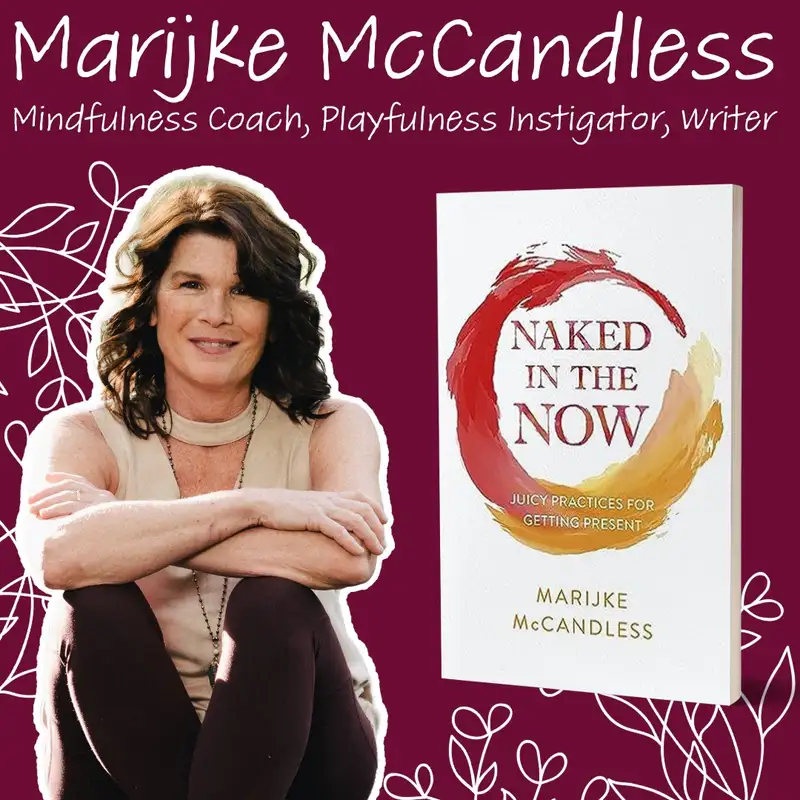
Hello and welcome back to the premise. I'm Jennifer Thompson and I'm Chad Thompson. And today we are here with Marijke McCandless, who is the author of naked in the now juicy Practices for Getting Present. And this book is the kind of book that you want to sink into. You can do it all at once or over the course of many weeks, sinking into getting to know yourself.
00;00;33;06 - 00;01;02;28
And it's so beautifully written, and it's like a personal guide for all of these things that maybe sound a little scary, like meditation, for example. So you're going to love this conversation with Moraca. So before we jump in, let me tell you a little bit about her. Marijke McCandless is a writer, mindful mindfulness coach and playfulness instigator who helps people shed their inhibitions and skinny dip in the present moment.
00;01;02;28 - 00;01;27;29
She leads a popular online writing practice called Right Now, Mind. Her first book, a memoir called More Journey to Mystical Union Through the Sacred and the profane, written under a pen name, won multiple awards. Her essays have appeared in nationally recognized periodicals. She is known for her playful attitude, tenacious spirit, and adventurous soul, and you can often find her rock climbing.
00;01;28;01 - 00;01;57;05
Moraca. Welcome to the premise. Well. Heart. Jennifer. Hi Chad, really nice to be here. I'm so glad that you've joined us. This book has won many awards. It's gotten some incredible, incredible accolades and endorsements, and people are really loving this book. And I got to tell you, listener, I remember when I started talking about writing this book, and so I'm really excited to dive into this conversation and talk about what it has become, which is fantastic.
00;01;57;05 - 00;02;08;12
So congratulations on that note. Thank you. Yeah. So talk to us about what it means to be naked in the now.
00;02;08;14 - 00;02;43;21
What does that mean? What does this mean? Yeah. Do I actually do I have to get naked to read this book? Wait a minute. I'm supposed to wear clothes for this interview? Thank you. So funny, when I was, when I was first getting used to speaking the name out loud, I can remember accidentally saying that it was called naked in the now juicy practices for getting pregnant, I subconscious was playing hard there.
00;02;43;24 - 00;03;25;22
But anyway. No, you don't have to get literally naked for this book. What this is, is an invitation to experience who you are beneath your thoughts, beneath your pressures, beneath your tensions, even your desires. It's it's an invitation to be willing and curious, to experience the felt sense of being this itself, which is often covered up by, you know, kind of like what we think about life instead of just resting in the experience of life.
00;03;25;25 - 00;03;57;19
And I think you you just used a word that really resonated with me. And, you know, that is the pressures of life of we we're under these assumptions, you know, that we have to be a certain way. We have to perform at a certain level or we're not doing it right. Yeah, yeah, I know, and it's, you know, that was my worry in writing this book that it would, it would, would be something that people would add to their should do list.
00;03;57;20 - 00;04;52;25
Oh, God. Yeah. I've got I've got to learn how to meditate. I'm going to I'm going to do that. Right. Because it'd be so good for me. And but I wanted to flip that whole attitude and mindset on its head. And that's why I made these practices all really short and really accessible. So in ten minutes you have the opportunity to I like to say you have the opportunity to experience delight right now, no matter what's going on and what what I have found is that especially when we're under a lot of pressure and we have a lot of things on our to do list, what we tend to want is an endless period of
00;04;52;25 - 00;05;35;14
time before us where none of that is there. We somehow want to become people that don't have thoughts, don't have pressures, don't have tensions, and don't have desires. But right. But it turns out that there's a different thing you can do. You can just practice. Turning your attention briefly to these moments that we have all day long where, you know, you glance out the window and the jacaranda tree started blooming and you're like, oh, it's just like a little tiny in-breath.
00;05;35;14 - 00;06;05;04
And so my, my hope is to show people that they already have it a lot. It's just that we're trained to overlook it. So this is an invitation to come back and ever so slightly expand those tiny little moments of delight that happen all the time. One of my favorite stories in the book is it takes us back to your childhood.
00;06;05;04 - 00;06;30;17
And, you know, that's one of the reasons I think that this book is so approachable is, you know, you're really sharing your personal experiences with us and how you came to know being naked in the now and this particular story. You're a child, you live in Bellevue, and you've discovered that there are four leaf clovers, and four leaf clovers bring you luck.
00;06;30;19 - 00;07;03;07
And it's such a beautiful little anecdote about innocence and that idea of being naked in the. Now, can you can you tell our listeners about that, that just that moment in your life and why it matters? Yeah, it's. Yeah. So, you know, we lived in a sort of a lower middle class suburban rambler in, in Bellevue, Washington. And I remember that our front yard was grass.
00;07;03;07 - 00;07;31;24
I was young, you know, for years old, maybe five years old. And somebody had told me that four leaf clovers were lucky. This also came along, by the way, with, you know, rabbits feet and other sort of weird things, right, that we all have. Yeah, yeah. This is the 70s, right. Or the early, early 70s. Yeah. Yeah. Well this was yeah, this was probably even in the 60s.
00;07;31;24 - 00;08;02;06
But anyway, so I would go to our front yard and, and you know, it's in Washington. So if it was a sunny day it was already a celebration, a miracle. Yeah. Yeah. But I would be fascinated and I would have this, this vat of patience. And I would sit on the ground and my little tiny hands would sort of separate out the clovers looking at each one.
00;08;02;07 - 00;08;38;29
Nope. That's a three leaf clover. Nope. That's a three leaf clover. And just be willing to sit there for a long time. Looking for a four leaf clover. Now, I knew it would be hard to find because it wasn't hard to find. Then it wouldn't be special. And so. But much, much later, I realized that that's really ultimately what we're doing when, you know, it's like what the Buddhist call Nettie, Nettie.
00;08;39;00 - 00;09;18;19
Not this, not that. And they're trying to point you to this stillness that happens when you're not all caught up in what you're thinking about. And here as a child, I was essentially recreating that I had this this patience and this focus and a willingness, really, and a curiosity for whether whether I would run into a four lane clover and, you know, and I did not many I think I found just a couple in my childhood and those were, you know, preserved in books that I still have those four leaf clover somewhere.
00;09;18;20 - 00;09;38;03
Oh, wow. That's cool. That's super cool. I recently was looking through an old book and I found a bunch of pressed flowers, and I don't remember putting them there, but I know I did because I used to do that and I'm like, yeah. If we could get back to that childlike mentality of having patience and, you know, keep using this word curiosity.
00;09;38;03 - 00;10;34;24
And I guess we sort of lose that, don't we? Well, we can yeah. We because we're trained that what's more important than being curious, which as a child is, is proving that, you know, something, proving that you have figured something out and that you are the expert that becomes considered more valuable. And it's it's not that it's not valuable to to learn something and become an expert at it, but if it's in, if it's in place of remaining open, remaining, curious, remaining available to a different way of thinking, available to see whether a lot of times are our our cherished values, somehow they know they might no longer serve us.
00;10;34;25 - 00;11;17;21
But it takes a lot to go and investigate whether your own values are causing you more suffering or, you know, alleviating suffering. Do you have an example of of what that might be? You know, the example that comes to mind is not my example at all. But it was a an older woman who I, I worked with writing her book, actually, her name is Nettie, and Mary was a child of well, I mean, she essentially grew up in Basque Country and moved to South America and eventually moved to America.
00;11;17;22 - 00;11;49;10
But she grew up with under a pretty strict Catholic upbringing. And it's not that there's anything wrong with the Catholic upbringing, except that for her, it was no longer serving her. She was not. She had become. Yeah. You know, she had she had let herself become the perfect Catholic mom in place of, of retaining her own vitality. Right.
00;11;49;11 - 00;12;16;15
And, and so she needed to go back and investigate. Oh, what parts of this are not serving me? And she had to let some of the her entrenched ideas about what it meant to be a woman, what it meant to be a mom, what it meant to live in this life. Go. Because they weren't she she was. She had lost her vitality for living.
00;12;16;17 - 00;12;39;17
Wow. Yeah. And I know the story you're speaking of, and it's a pretty powerful story. I'm trying to remember the name of her book. It's called The Missing Piece. That's right, that's right. Yeah. Now a Lata Lata. I can't remember how to pronounce her name. I can't remember how to pronounce. I know it is like that. It does begin with an L.
00;12;39;18 - 00;13;16;06
Yeah, Lata, I think, but but yeah, yeah. So that's so true. Like, we not only do we have the stress of trying to be successful and trying to be worthy to ourselves, which is, you know, one of the most beautiful things in your book is not only are we being taught how to love ourselves better, how to be better humans, we're we're taught how to love others better to, you know, these simple practices, these mindfulness practices that just remind you in such a, a simple way that you can love yourself and others to and be happier in so doing, be happier.
00;13;16;07 - 00;13;39;19
You know, you teach things like listening reflectively, respecting other space. Smiling was a good one. I was like, oh yeah, we feel better when we smile, don't we? It's true, having the hard conversations, you know, it's like, this is this book is like a masterclass in learning how to be a better human and being better to ourselves. And I love the idea of being naked because.
00;13;39;22 - 00;14;14;15
And I got to say, and we should talk about this like you made a conscious decision to really include provocative phrases in this book. I did talk to us about that decision and why that was important to you and how it how do you think it affects the reader's experience? And in getting to know themselves and stripping down which there it is of another provocative word or phrase, stripping down and getting rid of all the pressures, like why did that resonate with you and become part of the story?
00;14;14;18 - 00;14;49;22
Well, I like to, so being naked is one of those things that it's kind of got. It's kind of a double edged thing. Right? So from one perspective, we don't want to be naked. It's very scary. Yeah. Yeah. Scary. And it's the source of nightmares that you suddenly end up, you know, whatever naked going to college or something, you know, and it's it's just you feel exposed and you feel too vulnerable, and you, you want to protect yourself and cover up.
00;14;49;22 - 00;15;13;18
But the other side to being naked is, is is really juicy. And it points us to a sort of a fun, lighthearted vitality. You know, something like you might experience, let's say you've just fallen in love and you've started dating or something, and you've gotten close enough that you know you're going to take it to the next step.
00;15;13;18 - 00;15;43;15
You're going to maybe you're going to maybe get naked with each other, and it takes this certain kind of trust to do it. And you do need to feel safe. But there's also this underlying playfulness where all of a sudden you kind of get it. It doesn't really matter if I'm absolutely perfect, this person is in me and that's, you know, and that's how we get what.
00;15;43;16 - 00;16;21;25
That's how we need to be with ourselves. Right? You know? Yeah. Yeah. Well, I mean, you said it's like being vulnerable with yourself. That's what this is. Yes, it is. And it's scary at first because, you know, because we're kind of used to the masks that we put up there. They're comfortable to us. And, and it's risky to take them down, but there's a whole lot of potential that lives behind those masks.
00;16;21;28 - 00;16;52;21
And it's just unclear what that looks like. When you're behind the mask, you got to risk it. You got to risk get naked with yourself. And then once you start to get naked with yourself and you become a confident, you're able to be more vulnerable with others, too. But in a way that that I think is it's better for you, because if we know ourselves and we know what we're capable of and we know what we can handle, that allows us to move through the world, I think, in a more protective way.
00;16;52;22 - 00;17;27;07
Right. That's a really good way of putting it, actually. Yeah, I like that. So we talked about these intimate terms. I just want to throw some out because they're kind of awesome. So we've got pillow talk which by the way I want to talk about naked striptease. Slip into something more comfortable. But the pillow talk one was really important because you compare it to actual pillow talk after, you know, an intimate experience with a lover and why that matters and how it brings you into yourself.
00;17;27;10 - 00;17;55;28
Yes, yes. So let's have a little pillow talk. Marika. Let's go there. Let's go there. Okay. Well, part part of the. We were talking about these terms or whatever, and and I used it to be evocative because I wanted people to get in that mode where they were feeling playful and. Okay, so with the pillow talk, it's, it's another thing.
00;17;55;28 - 00;18;36;28
And I'm talking about pillow talk with your inner beloved. And what it looks like is so a lot of times we think we know what's important to us. We think we know what we want to talk about. But if we let our words flow in an unrestricted way, a lot of times a new topic will come up. So it's a little bit like when you're laying there, you know, it's pillow talk time and everybody feels safe and protected.
00;18;36;28 - 00;19;09;09
And they kind of like branch into something like, you know, God, you know, do you remember when you were ten years old and you, you know, and it goes into some terribly vulnerable story of embarrassing story from when you're a ten or whatever. But it's okay because we're all there in this little cocoon. So. Yeah. Yeah. You. So I just it's such a good transition now that we're going to leave this topic.
00;19;09;09 - 00;19;36;28
But right now, mind, I mean, that's what you you put together a program that encourages people to do just that. Right, right. And that's actually right where I was going with it. No. Good, good. Yeah. Yeah. Go there because because so so right now mind. Is it right now mind itself is a virtual online writing practice community that I created, created just around the time of Covid.
00;19;37;00 - 00;19;41;22
What it is is it's a.
00;19;41;24 - 00;20;20;13
It's basically based on its drawn from the principles of writing practice pioneer and Natalie Goldberg, who kind of taught us what free writing was. So free writing is when you write without thinking, you just you just let the words flow. So right now, mind is is riffing off of that. And so what you do is you is there's a very, very brief, open ended prompt like I remember or I feel and then you, you write the rules or keep your hand moving.
00;20;20;15 - 00;20;42;29
Don't think basically, and you set a timer, you have to set a timer and then you just write whatever wants to come out, whatever wants to come out. And if you stray from the topic, that doesn't matter. If all you can think about is you know what you want to have for lunch, then that's what you're writing about.
00;20;43;01 - 00;21;14;11
So it's this freedom of expression that helps us. What I like to call it befriend our mind. It helps us. It's it's a little bit like pillow talk, which might be really light hearted. It might be really, you know, silly. Or it can go really deep. And the possibility and the okay for it to go either way is what makes it precious.
00;21;14;14 - 00;21;45;22
And but it's sometimes it can be hard to stay with what wants to come up, but it can be profound. Yeah, yeah. There is a line in your book that I wrote down scale the Cliffs of consciousness, daring to enter the . That's. Yeah, that's kind of what we're talking about here. Right? Which, yes, this is one of my favorite sayings.
00;21;45;24 - 00;22;14;27
You know, when I'm working with authors and we're branding, you know, a lot of what we're doing is overcoming fear. And so I always have the same like you can if you can step just over the threshold of your comfort zone, there's magic there. Like there's there's a very special little space there waiting. If you can just step over your comfort zone, not too far, but just enough to find that that that you're saying, yeah, that's beautiful.
00;22;14;27 - 00;22;47;11
And sometimes the quote unquote , it's actually known to us, but we haven't allowed ourselves to process it or rethink it or re-experience it, or we haven't maybe wanted it to be true as to who we are. A lot of times there's complex pieces of shame attached to whatever it is, and we God knows we don't ever want to feel ashamed.
00;22;47;11 - 00;23;18;26
We want to feel perfect and in control and, you know, brilliant examples of humanness. Yeah. Which, which, which when we when we're thinking that doesn't include being all messed up and crying every day for seven years. And, you know, having had difficult things happen to us and being less and skillful in our communications. No, it only includes the perfectly curated version of ourselves.
00;23;18;28 - 00;23;40;13
Sounds a lot like social media, which I think is real problem because we do see these perfect worlds, and that's just not reality. And it's not fair, right? We're we're expected to be that. But we're also like judging others in a very unreal environment, you know, that sets bizarre expectations. And it makes me worry about our younger generations.
00;23;40;16 - 00;24;10;11
Well, they'll find a way. We always do. Don't press presents will find a way because yeah, we adapt. Yeah, there will be I don't know what it will be, but it will be creative and it will because. Because as humans, even though we spend a lot of time not being that way and doing all these things, in the end, you can't deny that the experience of presence is actually what we want.
00;24;10;13 - 00;24;39;21
So you will come back around to it. You'll know. You'll notice it in your lives. A lot of people take to going outside. You know, where for some reason they feel more present. Yeah, I absolutely do. If I'm starting to just feel weighed down by life, if I just go walk outside, everything shifts. It's like this, you know, looking up at the trees you were talking about, you know, just noticing things around you.
00;24;39;21 - 00;25;07;23
And I think because we let those other things take a backseat for a couple of minutes, and it does something really profound in the shift that happens is pretty incredible. Yes, exactly. And what I tell people so we've all heard about like, how powerful a lot of people report keeping a gratitude journal is. So taking this moment out and writing the things that you're that you're grateful for.
00;25;07;23 - 00;25;35;27
So what I tell my students is, oh my gosh, yes, that's wonderful. Definitely do a gratitude journal. But try this to try keeping a diary of daily delights. Try just noticing. Oh my God, I actually love my two minutes when I sit on the patio with my cup of coffee. It's like priceless to me. Yeah, and let it be okay that it's only two minutes.
00;25;35;28 - 00;26;01;04
Let it be full. Let it have its do its due is valued higher than what two minutes sounds like. So true. And you know what? I've tried so many times to do a gratitude journal. And every time I buy a new journal and its prey to me. And it has, like all the things about it that's going to be successful because I bought the right one and I last about a week every time.
00;26;01;04 - 00;26;22;10
Yeah. Yep, yep. I know, I know, we have a lot of empty journals around this place. We really do. It's totally true. Yeah, but that, you know, and what you're talking about, and that's what I love so much about this book, is you're giving people permission. There's not a right way to do it. No, there's not a right way to do it.
00;26;22;10 - 00;26;52;27
And I think it's somebody like Chad who with with his eye for photography. Right. He's capturing these little tiny moments of delight. Every single photo shoot that he does. And, you know, photos are kind of another way that we do it. It's just that we don't give ourselves credit that we've done it. I'm just saying shift your attention slightly towards giving yourself credit.
00;26;52;28 - 00;27;15;17
Oh my god. Yeah, I would normally say life is really sucky right now, but if I actually look at it, it's amazing that I had that moment and that I had that moment, and that I turned to my husband and smiled and that I. And then you just start collecting this different view of yourself, which is very helpful.
00;27;15;17 - 00;27;48;25
And it's in that view, not the judgmental one, that you can go deeper, that you're more willing to spend ten minutes doing a pillow talk exercise, or ten minutes of self-inquiry, or because you feel like you're actually okay and you're not screwing up life. But, but, but but yeah, so many butts. Yeah. Well, I mean, I guess what like my takeaway is and so I've tried to meditate.
00;27;48;25 - 00;27;58;17
I'm really bad at it even though I really want to do it. Pardon me, but you click us, Chad.
00;27;58;20 - 00;28;23;04
I've tried to do it and it's because I've put these expectations on myself. And so what your book has done is it gives very short, pretty easy exercises that remind us to not be so hard on ourselves, to not have these expectations that you're doing it wrong or I'm not doing it right. And there is a moment actually in I think it was the awareness chapter.
00;28;23;05 - 00;29;15;07
I think it's chapter five where you were causing yourself. I think you were at a retreat for the weekend and you got a you actually got a migraine because you were trying so hard to do it. Right. And then something shifted. Right? Right. And that is a beautiful moment. Probably. You know, it's a transformational moment when you're sitting to meditate and you're you're beating yourself up because all you're really doing is planning your day, right, or whatever, or reliving some mistake that you made or more likely, yeah, you know, and so and so what the thing is, is that once you realize that your thoughts are not going to go away, so to speak, thoughts
00;29;15;07 - 00;29;45;13
are natural. They're going to arise, they're going to pass away on their own. We just attach our identity to them. So what all meditation does is train us to notice when our attention is on our thoughts. And you can you, if you spend your whole entire meditation period of whatever, five minutes thinking about what a failure you are, and then and then you go, oh, that's a thought, right?
00;29;45;16 - 00;30;09;28
You have completely 100% succeeded. This goes back to what you said earlier. Neti. Neti. Yes yes, yes. Not this, not that, not this, on that. Yeah, I like that. So I mean, what we really need to be doing is just acknowledging what is happening and being okay with that. Is that right? Exactly, exactly. That's a nice way of putting it.
00;30;10;00 - 00;30;39;15
You know, I meditate every morning for like 20 minutes and a lot of mornings there's so many thoughts happening. It's not like I'm off in this blissful, never, never land. But when I notice the thoughts these days, there's this subtle underlying smile. It's kind of like, oh, look at that cute puppy. You know, the puppy's just doing what the puppy does.
00;30;39;16 - 00;31;18;22
It's all right. And there's this. Okay. And in that, okay is the is the treasure of of meditating. Because that gives us the space to play a little bit longer in the gap. I want to tell a story about you. I don't know if you're going to remember this, but it was the first time I met you and I was taking a writing class at UCSD, and you came as a guest speaker, and you had us follow our senses or lean into our senses and use our senses for writing.
00;31;18;24 - 00;31;39;18
Yes. And one of the things that you had is do was we you blindfolded us and you had us taste something, touch something. And there was one other, and I don't remember it, but it doesn't matter, because the taste one is the story I want to tell you. So we're blindfolded and we're tasting this juice and we're blindfolded because you don't want us to see the color, which was brilliant.
00;31;39;18 - 00;31;43;07
And.
00;31;43;09 - 00;32;07;06
So we taste this juice, and then we're silent for like a minute, and then you say, okay, now write something, anything that comes to mind. So you were asking us to tap into our subconscious based on this experience, a sensory experience. And I wrote this story about being five, 4 or 5 years old in northern Idaho, up in Gold Cup Mountain.
00;32;07;06 - 00;32;29;00
And my mom is in the garden, and I'm sitting in the garden and I'm pulling carrots out of the earth, and I'm eating these carrots. And I remember my mom's jeans, and I remember the way the sun was reflecting, like it brought me into that moment so viscerally. It was actually like, whoa, right. It was like the snapshot of a memory that I hadn't remembered in a really long time.
00;32;29;00 - 00;32;48;21
And I wrote this whole story about eating these carrots right out of the earth. And then we get to the end of the exercise. And so you go around the room and you say, okay, everyone, what were, you know, what was the juice? What were you tasting? And I said, beets. And everyone had a different answer, right? Yeah.
00;32;48;24 - 00;33;10;26
And then it turns out it was carrot juice. And I was like, oh my God. Like, how did I not put that together? That I just wrote a story about eating carrots. But somehow in my brain I'm like, oh, it's beast. And that really it really stuck with me, you know, of like our subconscious. So I would like you to talk to us about how we can tap into our subconscious, not just for writing.
00;33;10;26 - 00;33;34;25
And I know you're a writing coach, and that's a big piece of this, because most of our listeners are, in fact, writers. But how we can tap into that for just living a more present, mindful life? I love that story, by the way. I can remember another person who said, who wrote this is what green tastes like.
00;33;34;27 - 00;34;02;25
You know what? What really brilliant thing to say. You know, I don't care it juice. Right. Anyway, so it truly, truly, I think one of the most powerful ways to tap into that kind of subconscious is through what this is what I call naked writing. And so what we were doing that day at UCSD was a form of naked writing.
00;34;02;25 - 00;34;35;26
We were using what I called sensory awakening for writers, but we were writing without thinking and without worrying about our grammar or our punctuation or our spelling. We were just letting the hands move and and all often, often, often what happens is these incredibly brilliant, very visceral stories come forth. And that that is that's the beauty of this naked writing.
00;34;35;26 - 00;35;15;25
I'm actually working on this really, as a topic for talking to people about how to tap into their subconscious, how to become more comfortable with being naked in the now, and how to connect with other people. Because when somebody like you in that class reads aloud, their words that are totally uncured did absolutely in the moment. They're so authentic and so honest, even if they maybe aren't perfectly, you know, put together.
00;35;15;26 - 00;35;48;06
Right? You know, they're not they're unedited. Right. But once we begin to listen to other people doing that, we begin to see other people in ourselves and we begin to get it. Oh, it's not in the perfection with which they told this story that makes me want to listen. It's in the authenticity of the story. And so for me, naked writing is truly a doorway in.
00;35;48;09 - 00;36;17;05
There's other tricks you can use. There's, you can practice just talking to yourself on a recorder and asking yourself what it wants to talk about. If you're not a writer, there's a there's a teacher, Cheri Huber. She she does. She calls it recording and listening. And so basically and it works really well if you're in the middle of some yucky thing.
00;36;17;06 - 00;37;02;25
Right. So you give yourself a chance to speak that completely out, like, oh my God, I'm never going to live through this. My back is killing me. I can't do the 25 things that are on my to do list. I'm failing at everything I'm doing. You just speak it all in there, and then you listen to that person and and the beauty of it is you then record a response to that person where where it's it's like you're, you know, higher self is kind of an overused phrase, but it's sort of like you're sure he calls it your mentor, where that part of you just speaks compassionately to that person who's experiencing that.
00;37;02;25 - 00;37;34;01
And so, you know, it might be something like, oh, man, I hear you. You've just been through so much. Wow. And you're just with the person as they're going through something, and then you erase the first recording and you only listen to the second one. Oh, okay. Interesting. This is really isn't that isn't that an interesting. So that's one of my that would be it's it's not an exercise that I created, but it's one that I think is brilliant.
00;37;34;01 - 00;37;57;24
And I honor Sherry Huber for bringing it to the world. Do you ever watch Twin Peaks? Oh my God, I used to, yeah, some. There's a theory going around that basically that's what Agent Cooper is doing when he's talking to the recorder and that he's there isn't actually a Diane. Diane doesn't exist, or Diane is dead. Right. Depending upon which conspiracy theory you go down.
00;37;57;27 - 00;38;28;24
Yes, yes, we are all Agent Cooper and mystery woman, Diane, within our own selves. There you go. I really like that theory. That's one of my favorite shows. You know, we're getting to the end, and I really want to talk about more. Listeners are like, what more do you want to talk about? I want to talk about your first book, which was mentioned at the opening, More Journey to Mystical Union Through the Sacred and the profane.
00;38;28;24 - 00;38;47;27
And I think the reason I really want you to talk about it is you said something that seven years of crying, you know, that sort of just sort of slipped past us, but you actually went through a pretty hard time, which is why I think you've come to who you are as a human today, and partly why this book is here to help others through hard times.
00;38;47;27 - 00;39;10;09
So can you tell us a little bit about that book and where how it has helped you create the person you are now? The backstory? Yeah, exactly. What's the juicy backstory? You know, so, so.
00;39;10;12 - 00;39;52;26
Yeah, so so more was the memoir that I wrote about a period in time, which was the catalyst for which was, you know, a personal crisis, a personal and marital crisis. So, you know, the the quippy way of saying it is, I walked in on my husband and my best friend together, so it was a devastating pull the rug out from under you moment, of course, and all of the.
00;39;52;29 - 00;40;29;09
Okay, so the the saving grace was that there was a couple of saving graces. Basically you can anybody can imagine if that happens. It's a crisis. It's it's obvious crisis in the relationship. Something is askew. You're not addressing something. What are you are you going to separate? So we realized that we were at a crisis in our in our relationship and that we could separate, we could decide to stay together.
00;40;29;09 - 00;41;13;02
And the two ways of staying together were pushed this under the rug and pretend like it never happened, or dive deeper into what was, what was awry, what was what was happening beneath the the overt act. So ultimately, we decided to dive deeper. And we we went to traditional couples therapy and individual therapy, but we also took a nontraditional path, which was we did what was called a year long love and ecstasy training.
00;41;13;04 - 00;41;39;03
And it was when you learn to love yourself, too. Yeah. Yeah, exactly. And it's where I learned the principles of meditation and the principles of self-inquiry and the principle and the the power of vulnerability and transparency, even in a relationship. And.
00;41;39;06 - 00;42;24;20
It's a bunch of other stuff, too. But in that. So so this was it was a year long training that happened over three, ten day retreats. And then in between the ten day retreats, there were little monthly weekend gatherings. So it was a huge commitment in the middle of your regular life. But it wasn't 365 days. It was, you know, but what happened during this very deep work, therapy work and this love and ecstasy training was that, memories of childhood sexual abuse began to arise for me.
00;42;24;26 - 00;42;29;25
And I.
00;42;29;28 - 00;43;17;06
Just had to come face to face with something that I had swept under the rug so deeply that I wasn't even aware of how it might have been contributing to my behavior, to my clinging to my neediness, you know, to to smothering my husband, so to speak. And one of the things that happened during this incredibly difficult period of flashbacks and reckoning within myself, because at first I didn't believe it at all, and I had to do a lot of work to go back in time and verify.
00;43;17;06 - 00;43;51;00
And, you know, in my head, I had just had this perfect childhood and everything was great. And then to suddenly have these visceral flashbacks was devastating. But also what happened was, and one of the things that helped my husband and I rekindle our trust was that he showed up for me as I was going through this. Yuck. And he was he was so present.
00;43;51;01 - 00;44;34;15
He wasn't actually afraid. He was 100% there with me. And that taught me so much. It just taught me how somebodys presence can change your experience of the moment. It can change how even how you view yourself. I just thought I was broken and there was going to be no fixing this. He just thought he just saw me as having some tough stuff that had happened, and he was going to be there for me as I worked through it.
00;44;34;15 - 00;45;09;25
And that was profoundly impactful. Yeah. Wow. Well, it's an extraordinary book. It's it's quite a journey to take that, you know, that time with you. And to me, it makes total sense. You know, knowing the history and reading that book and then seeing this book of how you've turned these practices and these realizations into something that people can use every day to check in with their own trauma and check in with their own history, that creates these pressures that we don't even know we're putting on ourselves, these expectations that we didn't really put on ourselves.
00;45;09;25 - 00;45;40;17
But we did. And that's part of it. Right? Right. And that first that first book is also part in parcel, because it was such a journey that did involve sex, just not in the way you think in a way. But that's part of why naked and Then now uses those terms. Because for me, it's just a metaphor for getting to the juicy goodness of life.
00;45;40;20 - 00;46;09;07
And what a beautiful thing. If you can give yourself that space. Yeah. Which, you know, brings us back to playfulness and, you know, your writing courses and everything you do has such a a playful way about it. And I guess what I'd like to end with is, do you have a favorite playfulness practice that you can share with people to just give them a little taste of what this is all about?
00;46;09;09 - 00;46;39;28
Oh my goodness, you know it. I don't know that I actually have a particular practice that I could point to right now, but there is this if, if you're if you're listeners can just imagine putting a twinkle in their eye when they listen to something that they don't agree with or that they think is the wrong way to go.
00;46;40;00 - 00;47;04;09
I mean, we have lots of opportunity for that right now. Yes we do. You know, we're all at odds with each other. And and I'm not suggesting to do this on a, on a big scale. I'm talking about a little thing like like, I don't know, your husband doesn't take out the trash. So it could be this. I know, I know, not your husband.
00;47;04;10 - 00;47;43;19
Of course. Of course, of course not. But I'm just I'm just saying something silly. That. That where, you can put if you just put a twinkle in your eye and imagine, just just for shits and giggles, imagine how you could, instead of being all upset and disappointed. And again, this thing wasn't done and now you're going to have to do it or whatever.
00;47;43;21 - 00;48;33;27
Just imagine that it's an it's a private inner joke between the two of you and that it's, it's a secret message that if when he doesn't take out the trash, what it really is, is a secret message for you within yourself to choose playfulness and lightheartedness. It's like the universe saying choose. And so then when something triggers you, instead of it being a trigger that then starts a fat a a, you know, whatever downward spiral it, it triggers you to go within yourself and, and create a little gap between your response and your your reaction between your the stimulus and the response.
00;48;33;29 - 00;48;49;12
Actually, the newsletter I just wrote is sort of a version of that where when something terrible happens, instead of saying, oh my God, something terrible just happened, or oh my God, he didn't take out the trash again, you replace it with isn't that surprising?
00;48;49;14 - 00;49;09;23
Wow. I'm going to use this as my cue to smile. So it's not really about like play in the way we think of children playing. It's more about being playful and how you respond. At least that seems like that. Maybe that's part of it. Yes, I would say that's a good way of putting it. It's an it's an attitude of playfulness.
00;49;09;29 - 00;49;34;03
Because because when we have that attitude of playfulness, we are not we don't have an agenda. Play doesn't have an agenda. So things don't have to turn out a certain way in order for it to be a good result. Right? Right. Lessons to to take with us. What are you working on now? What's what's the big thing happening in your life right now?
00;49;34;04 - 00;49;58;22
Maraca. Well, actually, I'm just getting ready to teach for the first time at the Las Vegas Writers Conference. Nice. And that's happening. April. No. Yeah, the Las Vegas, the April 23rd to the 25th. And actually, Jennifer, I'm going to be doing a sensory awakening for Writer's Workshop. I haven't done it in a really long time. Nice. I wish I could go.
00;49;58;22 - 00;50;21;21
That would be so cool. I think I'm going to be in Portland at that time, but that would that. That's awesome. Yeah. So that's that's the next big thing on my list. I'm also, I'm also traveling to Washington and I'm going to be teaching back again there at Village Books, which was a wonderful, a wonderful thing I've done.
00;50;21;21 - 00;50;55;03
I've got right now mind going, I have in-person events once a month in Las Vegas at the Blue Diamond Library. I do an in-person, not an in-person, but a virtual event every week. I do right now, mind, which is a virtual online free event. And then I do these periodic workshops and retreats throughout the year. So that's kind of the the main thing that I'm going on, because I also still love to get out rock climbing.
00;50;55;03 - 00;51;19;00
I also still love to play with my grandkids. Yeah, there's a lot of good things happening. Lot of good things. I love it. Well, thank you so much for joining Chennai today. We really appreciate it. Oh, I'm so glad to be here with you guys. Well folks, please visit Mariah on her website Mariah. Com also check out our Substack.
00;51;19;02 - 00;51;41;29
You can find that same way. It's called the Naked Now letter, which by the way I love that. And you can find that either through a link on her website or just do do a Google for naked in the now. Also follow Marijke McCandless on LinkedIn, Facebook, and Instagram. Instagram. Amrica McCandless. This has been another episode of The Premise.
00;51;42;00 - 00;52;01;23
You can visit us online at The Premise Pod, and be sure to subscribe, rate, and review the premise wherever you get your podcasts. Those reviews really help us get the word out, and we just appreciate you being here with us today. You can follow me, your host, on Instagram and Facebook at Jennifer Thompson Consulting. And till next week.
00;52;01;23 - 00;52;07;13
Thank you so much for listening. Goodbye. Goodbye. Goodbye.