Hello and welcome back to The Premise.
I'm Jennifer Thompson
and I'm Chad Thompson.
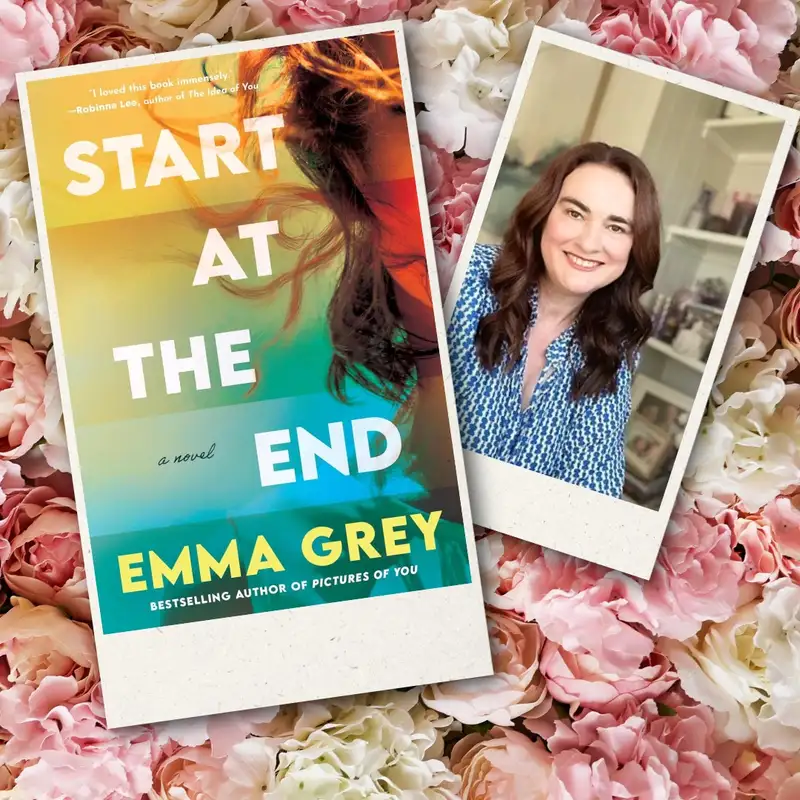
And today we are here with Emily
whose book start at the end
has recently come out.
And it is absolutely gorgeous.
I love this book.
It is about finding your voice.
It's about being vulnerable.
It's about grief and love
and trust in yourself.
And it explores the idea of
what if you know what
if this one thing affects that,
and where do we end up?
And it's about the messiness of life,
but it's also the beauty of life.
So I'd like to introduce Emma Gray.
She is the author of seven books,
including two international
bestselling novels,
The Last Love Note and Pictures of You,
winner of the American Independent
Publisher Book Award Gold Medal.
Her adult and young adult novels
have been translated internationally,
optioned for film,
and adapted for the stage.
She lives in Canberra, Australia,
surrounded by her three children,
stepchildren and grandchildren.
Emma, welcome to The Premise.
Thank you so much.
It's lovely to be here with you both.
Well, I am just delighted
and I know that, you know,
it's pretty early in the morning for you,
so we appreciate it.
We appreciate you
taking the time to talk to us over here
on the other side of the planet.
Oh you're welcome.
Yes. I'm coming to you from the future.
Technically on time.
You technically are.
Which works really well with this book.
We'll dive into that.
Boilers.
Yeah, yeah, we're going to do our best
not to have any spoilers today for you.
So I got to tell you,
I don't think I've cried
this much reading a book or, you know.
Well, I haven't cried this much
since I watched Steel Magnolias.
Oh, gosh.
Do you remember that movie? Yes, yes I do.
Whenever I read a really good book
that, like, I am just.
I'm so emotionally invested.
I always think of Steel Magnolias.
I cried a lot in steel Magnolias as well.
But this one,
you know, in a good way though.
But you know the middle is just gutting.
It's like oh I just felt your grief.
And of course at the end of the book
I read the acknowledgments.
And I come to understand that this book
is actually inspired
largely by your husband's
death, 2016, ten years ago.
And I was like, oh, no wonder, no wonder.
It's so visceral and and real.
And I mean, it was just
you're an extraordinary writer.
So there's that too.
I don't know that you have to experience
grief to write it
so well, but I'm guessing it helped.
Yeah. Well,
it certainly helped me to write.
It helped me to write about grief.
Help me in my in my grief.
I think it was very cathartic.
And I mean, I had known,
you know, when Jeff died in 2016,
I knew that
I was going to have to process
that loss through writing.
And I've been really doing that ever since
in different ways, and it has helped me.
But I think it's also helped
a lot of my readers
who've been in touch with me
over the last few years
and sort of thanked me
for articulating things
that are very difficult to put into words
sometimes, some of these deep emotions.
And I think that's the beauty of fiction.
I think we get to escape
into somebody else's world,
but if it's close to our own in any way,
it helps us to navigate our own losses.
Yeah.
So true and so well put.
And this book absolutely does that.
I mean, it was just so beautiful
and I was so invested.
And their experience,
all of them, every character.
And I just kind of wondered like, did
you know where this book was going to go
when you started writing it?
Did you have a kernel or were you
just writing and it started to evolve?
I tend to just write,
which does get me into some trouble
sometimes with my editors.
I do glad to hear that
I create a lot of extra work for everyone.
Because I don't plot
and I knew I knew broadly
what I wanted to try to do with this book,
and it was quite a challenging premise.
It is, I guess, a little bit of a spoiler
to say.
It's a little bit of a sliding doors
concept.
But, you know, and then that presents you
with this opportunity
to imagine two potential outcomes
for these characters.
And that was quite a stretch for my brain
at times.
You know, just remembering
what's happening on this side
and what's happening over here.
And but it was so interesting to do.
And, there was actually one entire draft
that we had to ditch where it had gone
a step further in complexity.
That ended up just being too,
almost too distracting for the story.
So sometimes that happens
when you don't plot
and you just take something too far
or try something a bit too
trying to be a bit too clever
and it may not work.
So again, that's where editing comes in.
And it's just I'm so grateful
to the people who can help me
straighten things out
when they go a little bit astray.
It was it really was
such an enjoyable book to write
because in addition
to the grief, there's also of course,
so much hope and excitement.
And yeah,
I know that's what I'm trying
to embody in my life this year as well,
with this 10th anniversary
since Jeff died,
to really be doing some things
in my own life that lift me up
and give me that hope for the future.
I'm starting at the end as well.
Well said. Wow. Yeah.
And ten years is
interesting that it
you know it happens on that
in that timeline.
Yeah.
I mean it feels like just yesterday.
And so I'm sure. But
and I do remember thinking at the time,
I couldn't
imagine getting through ten weeks and days
even at the start, you know, and,
and the, the concept of being here
ten years later, do it.
And talking about this with you,
going on a US book tour
next month, all that sort of stuff.
Just.
I would never have believed it back then.
It did feel like life was over. It was.
It was a sudden loss.
And, you know, you never prepared.
I think even if you do see it coming.
And so it really
I sort of wish I could go back
and speak to that earlier version of me
and say it's going to be okay.
And I
think that's what I'm doing
sometimes with, with some of this writing
for other people
who are at that much earlier
part of the, experience of grief.
Absolutely.
Well, and that's what really struck me
too, is you had this ability to show
and we are going to have some spoilers
here.
We can't really help it.
My God, you know, this what if scenario,
this butterfly effect
that you allude to in the book, you know,
and you got to dig into that and see,
you know,
how would he have gone on without me?
And I'll be honest with you,
I think I might actually start crying
because it was so
real and powerful,
and I could just imagine it,
you know, and and I have to tell you.
So years ago, I was driving.
I was in this intersection,
and someone didn't they didn't
stop at the stop sign, and they almost hit
me and I swerved and I had this, like,
thought in my head and was like, oh
my God, in another universe, I just died.
Yeah, yeah.
And Chad has to go on without me.
And I was and it struck me like, what if,
you know, and and so when I started
reading your book, I didn't realize that's
where we were going.
And I was like,
oh my God, this is so good.
But talk about the what if, like,
when did you decide
this book would dig in to the what if?
Well, I think actually soon after,
not soon after.
I got very early on after Jeff died,
I used to occasionally think
what would have happened
if this was the other way around.
I think because we had a young child
who was five at the time,
who's now 15 and towering over me.
You know, I, I would often wonder
how would he have handled everything
if if it had been me who had died.
Yeah. And where would they be living?
And he had been applying
for a job in Ireland
at the time, just before he died.
He was a professor of history.
And so would
the family have moved to Ireland?
Would my my little boy
have an Irish accent now?
You know,
what would they have done?
What would my girls have,
have studied at university or,
you know, just the entire family
outcome
could have been completely different.
And I think we all have experiences
in life where we we
look at where we are now,
and then we look back and think,
there was the crossroads back then,
and we either had something happen to us
or we made a decision or a choice
that sort of pushed us down this path.
Instead.
And we question, did
we make the right choice?
You know, is this where I should be,
all those sorts of things?
And this was an opportunity
for me to explore that concept
that I think it resonates
with most of us at different times.
And then to sort of show myself
that in either outcome,
everything would have been okay,
it would have been different,
but everyone would have found their way
through regardless.
And so that was really very therapeutic
to think.
I can imagine,
you know, in talking about Parker.
So she's five years old
and she loses a parent and, you know, so
we're watching her struggle
through both scenarios, which was God.
It was therapeutic for me,
you know, reading about how we how
we struggle through loss.
And she really came out the same in
both scenarios. Yes.
That's right.
That's I think that was really something
that I wrote for myself.
Sure.
Prove myself that my little child
was going to be okay in other,
you know, either outcome to she
she really becomes the hero of the story.
And I love that for her.
I just think it's so powerful
what she ends up doing.
And, you know, I've met a lot of, people
since my last who, adults now, but
who lost a parent when they were young.
And in every case, I've noticed
they are a strong, resilient person
who's done amazing things.
And I think that the loss
has really shaped them.
So I was drawing upon those people,
friends and others that I've met in life
who, just showed me that
it's still going to be okay for my son
and that, you know, this has been
a terrible tragedy in his life, but,
he, you know, his life is not over either.
And he's got,
a big future ahead of him as well. So
I love that character.
She really,
I mean, I, I noticed in different drafts
as, as I went
on, she just got stronger and stronger and
more prominent role.
Nice.
And that that, again, was sort of all a
surprise to me too, because I don't plot.
So when she we won't say what she does,
but when she steps up
and sort of becomes the hero
there, at one point
I just felt like cheering for her,
you know, I felt like she and,
it's it's really lovely.
She was a real person.
I mean, I you know, it's funny
when I reflect on the book
because it's really stuck with me
since I finished reading it.
And sometimes I stop and say, oh,
wait a minute, was that a movie?
Because they're so real in my head,
you know,
I can see the characters and I'm like,
oh yeah, this is a book.
I didn't see it.
I read it and, you know, good on you
for creating these characters
that are so real that I can visualize them
and remember them,
and they will stick with me forever.
Oh, that's really lovely to hear
because that's how I see it.
When I write it, I see it and be,
it's like there are a few producers
looking at it at the moment,
so I think it would make a great movie.
You know, I suppose all authors
think that that every book. But,
actually
my Pictures
of You novel is being made into.
Oh, it's been option
for TV series at the moment.
So congratulations. Yeah, yeah.
So I'd love to see this one on screen
because I think it's just such a,
it's a, a thought provoking concept
as well as a romantic and hopeful story.
But there's that emotional depth.
Yeah.
Well, well, I'm wondering
if you did much research on, you know,
there's a point in the book
where Fraser and Audrey are talking about
the idea of the multiverse, you know,
and really,
they're talking about string theory.
And so I'm just wondering, like,
how much did you dig into string theory
and this idea?
I've always had a casual interest,
just as an, you know, armchair,
marathon.
I don't have any science background.
And I often think, gosh,
I hope not too many scientists
read this novel, but, you know,
I'll be receiving some emails.
But it it has always fascinated me,
this idea of there
being multiple universes and,
I find it
I find it just
I just love that idea that we,
I love this idea that we don't know
who we're going to become
and that in another, as you said,
with your near-miss in the car,
you know, we have near-misses
all the time in our lives where we sort of
get almost a fleeting glance
of another version of ourselves
or something else that we could have done.
Yeah.
And, so I sort of love this idea of it
all overlapping in time.
And, you know, I did read
a really fascinating article about,
a concept called The Block Universe
about all time
existing now, and that at at all times
we are sort of we are alive.
We are dead.
We are babies in one part of the universe.
Now, we're a little six year
old over here, and then here we are today.
I'm 52 and I love that because that
that I found that a very encouraging thing
to imagine, having lost someone
because I was thinking, you know,
somewhere, somewhere Geoff is still alive
and and that's how I feel.
I sort of get the feeling
that he's still around me somehow.
It doesn't make sense to me.
Not like. But,
you know, I like to imagine that,
I love this so much.
And digging into this to me, like, I could
get really geeky with you on this part.
There's.
At this point in the book
that was so brilliant, where there are
characters are in two different timelines,
but they're in the same place,
and they feel each other,
you know, and, like,
Parker comes back from the bathroom
and she's like, I just it's a weird.
I feel like she was there
with me and like,
she was in a different universe
in another timeline.
Yeah.
Oh, no, I loved doing that.
I love thinking about that.
I was so impressed, too,
because you didn't do too much of it.
It was like
just enough to make us think about it.
But you didn't like.
You didn't overdo it.
It was great.
Yeah, yeah. Oh.
That's good. I'm
so glad I got the balance right.
That's again up to my editors.
Well, I
mean, yeah, everyone needs a good editor.
The other thing I really loved about this,
I recently just read another book
that had different characters.
So we would swap perspectives.
And, you know, typically
when I read a book that does that,
we're rehashing
from a different perspective,
like we kind of go
through the same scene, but,
you know, first it's this character A
and then we do a through character piece.
So we see the same thing over and over.
And you really didn't do that.
Like you would literally pick up
in the middle of a sentence,
but now we're in the other characters
head.
Yeah, I, I feel like that's a lesson
I learned, in my last book, actually
doing pictures of you, because it's also,
from both perspectives.
And I think one of my editors made that
point at some stage and said, you know,
we need to make sure that at every point
the story's progressing forward.
You know, at times
I would actually jump back in time.
But that was a time line shift.
But, it needed to continue to go forward
no matter what had happened.
Which was great.
Just to learn that because I think
you can feel a bit stagnant.
That's the trap with dual names,
you know, can feel a little stagnant
if we are rehashing, from somebody else's
point of view.
But there are ways to bring in
that other point of view in conversation
or something like that later on.
If you need to get, into that,
that other person's head.
And I think it's really important
when we write any scene to be thinking,
who needs to be
telling this part of the story?
Who has the
the most stakes
at this point in the story, and they're
the one that should be speaking.
So there's a whole
those kinds of little tricks
that you learn over time when you're,
you know, developing as a writer.
I wonder if there were times
when you were writing
and all of a sudden
it just switched to the other character.
I think they were they
were a couple of times where I went back
and changed.
I moved the whole chapter
into the other characters voice.
Yeah. We partly for that.
The reason I just outline,
but it was also sometimes just went, oh,
because I am a big rewriter.
So my, my structural edit
is usually just such an enormous endeavor.
And I do a very messy lot first draft.
So I like to sort of get everything down
on something down on the page to
then work with.
And and I think there were will
they were whole chapters
that that were deleted and
just so that if you do something
like that, that's quite radical,
then you might find,
oh, now I've got,
you know,
so much in a row from one person,
so I need to really balance it out
differently.
And sometimes
it was so much more powerful
once you put it in the other perspective.
Yeah, yeah. Interesting.
I find sometimes when I'm writing,
all of a sudden it will literally just
the perspective will switch.
And when I was a younger writer,
I thought, oh, I'm bad at this,
I need to, and I would force myself
to stay in that lane.
Yeah.
You know, and that's what I was being
taught in school.
But in following your heart
when you're writing is so important.
That's right.
I go every year.
I volunteer as a reading ambassador
for this local, government,
in Australia and, visit,
we call them primary schools.
You call them elementary schools
and talk to students about writing.
And I remember going in last year
and and one of this,
the kids asked about how much planning
to do and how much of an outline I have,
because that's what they taught.
Never start writing a story
without having an outline.
And here's the beginning and middle
and end and all of that.
And I of courses.
So yeah, yeah, yeah I do
I a slope a document and I knew that
the teachers were sitting there
thinking, oh what is she saying? But
but I just
needed them to know that they're
there are the rules that we're taught.
But then there's always other ways
to get a story on a page.
And really, a lot of it is experimenting
with what works
best for you.
But I will say I'm also a pantser.
But probably not a very effective one.
And I find that like I go back
and I read like that shitty first draft
and I'm like oh this is terrible.
And then I have a really hard time.
You know, getting back into it
because I'm too hard on myself now.
I think we all are.
And the problem is,
I mean, every time I sit down
and write a new book,
I look at my first draft and think, well,
that's it.
I forgotten how to write, haven't I?
To what is this?
And it's and it's very much
because you've just come through,
I don't know, 12, 15
drafts of the previous book
and it's been edited and it's, you know,
there's been several sets of fingerprints
all over that on the book, and now
it's on the shelf and it looks fantastic.
And you forget that
that book two was an absolute mess
the first time you wrote a draft.
So it's really about remembering,
because we'll only compare our first draft
to first draft
and compare anything at all.
Yeah.
Because it's just I don't know
if you've ever seen that video
by IRA Glass on the Taste gap.
It's such a great little video to watch.
A couple of minutes long, and it sort of
changed my whole perspective
on this because, he talks about the fact
that when we writers
and readers,
we read something and we know we can,
we can recognize because we've got really
good taste in, in reading and writing,
so we can recognize what reads
well and looks great.
And then we look at our own first attempt
and think, well, this is not that
I can see this gap between what
I've written and what I wish it was like,
and that where people fall down
is that they they get to that stage
and then they give up
because they're thinking,
I could never possibly reach that point,
forgetting that that everything
we're reading was once at that point, too.
I mean, I don't know
if there were any writers that are able
to put down an almost perfect
first draft, but I've never met one.
You know, it's much more common
that we're all just struggling
through multiple drafts and all
sitting there thinking, I don't know,
I can't write like my him or like her or,
you know, it's it's such,
we're kind of walking through this maze
of self-doubt all the time, and.
Yeah, that's even start submitting it
to publishers for rejection and,
you know, all of that sort of thing.
So, you know, oh, yeah,
we love rejection.
Yeah. It's a badge of honor, right?
You get to 50 rejections and
then you're like, okay, I've made it now.
Now I can start doing it.
Yeah.
How many drafts
or how long did it take you
to write this book once you finally, like,
had your first draft in place?
I think I did.
Oh, that was probably I think there were
about 12 drafts eventually.
That includes, you know, those last
little ones where you're looking over it.
And for copy editing
and that sort of thing.
And of course,
the one where we've had to change it
from a strict, firm Australian English
to US English and all of that, things
like the the term caravan, we call it
a caravan, you call it a camper trailer,
you know, all that sort of stuff
we've had to do work on.
That's always very funny. But,
I have, I mean, I always with each book,
I think I delete about 30 or 40,000 words
every time.
And, and, you know, the book's not long.
It ends up being,
I don't know, 90,000 or something.
And and that is just words
that were in an earlier draft
that I put in another file,
another file and never look at again.
And so, yeah.
So I'm very ruthless
when it comes to what I cut out.
I think really stories are made
by the words on the page
and the words that you delete as well.
Because the, the words that stay in
sometimes because we just cling to them
and think, no, I wrote that I spent,
you know, two weeks on that paragraph.
Yeah, yeah, killing our darlings.
I think that's it.
And sometimes those decisions
are the most important ones that we make.
Indeed. Yeah.
Well, in terms of wordsmithing,
the way you write about
music is so gorgeous.
And of course, I, you know, researched you
a little bit and discovered
that you actually did write
a, musical screenplay.
Yes, well, I did I mean,
I worked with a composer to write that,
but so I and I did
I had years and years of piano lessons
growing up, and I was always in
bands and orchestras and,
and then when I wrote my teenage novel
unrequited, it's called
I wrote it when my daughter was 14
and hated writing, but loved Harry styles,
as she's 25 and turned up on
the doorstep in tears this morning
after listening to his latest album.
So that has not changed,
and I wasn't going to say
I was going to ask that very question.
What does she think of his latest? Yeah.
Oh no.
She's so sick of telling me
that we we ended up having an access to it
earlier than some of the countries
because it was midnight release here,
and there were people on TikTok
saying they had seven hours to wait.
And, you know, she
I don't think she had any sleep at all.
Well, anyway.
Oh, they show later in the year.
But, so I wrote that and that novel
I wanted to show her that reading
could be fun because she was struggling
through all her English texts at school.
And I said, you know, reading
is just an escape into a fantasy world.
So I'll write a story about a boy band
and a young singer and songwriter
who hates their music
and thinks she's too good for it,
and then ends up falling in love
with one of them and co-writing a song
with one of them, one based on Harry.
Anyway, friend
to who I met in high school,
who is an award
winning composer in Australia.
Sally Whitwell read the novel
and she said, look,
I've never been interested in boy bands
or even in boys at all.
And, she said, I love this story
and would love to write a musical.
So we've actually
just sent off the proposal this week
to have a to, to our old high school
to see if they might,
put this on next year,
which would just be amazing
because we could be,
you know,
two former students, right? Yeah.
And, so cool, really fun.
But I just love telling stories
in different ways.
And to see, to be able to hand over
those characters to someone else
and let go a little bit.
And I'm learning
that with the TV series as well.
I said to the producer,
you know, we often argue
that the book is always better
than, than the screen version of anything
because we're writers and readers,
and that's the story we want to stick to.
But I really said to her,
I would love for the TV series
to take it further and be better.
And, you know,
I want every iteration of this story
to just grow and continue to develop.
And that might mean making changes
and that's that's fine.
I love that collaborative approach.
Yeah, I think that's really cool.
And you're right.
I mean, frankly, there's very few
or I can say, yeah, the
the TV show or the series of the movie
was as good a or if not better.
But I think you're right, it's
about making it its own thing.
And letting it evolve.
Yes. Because that's really
what we're looking for, right?
We've already experienced the book.
Now we want something more.
It's I think it's the soon
as soon as the book is published, it's
no longer entirely yours.
You've handed it over to readers,
and it's exists in their minds
and in every reader's mind.
They're picturing it slightly differently.
And and that's fascinating to 100%.
Oh, and I love that so much.
Yeah. Yeah.
Well I want to talk a little bit
about this idea of creativity
and actually you know it before we get to
creativity let's talk about academia.
Yes. Really.
Yeah.
We're all right Charles. Like why. Yeah.
You got to make it dry.
We're going to make it not dry.
So I mean part of the story
and our, our main character,
one of our main characters
Audrey, is she is in her doctoral program.
And you know, someone
plagiarize and steals from her.
And this, this happens
so often in academia with women.
Yes it does.
In fact, when I started researching that,
I was horrified.
But when I was turning up, it was just
the stories of of academic plagiarism.
You know, if you stiffy look that up,
you'll be there all day writing about it.
Oh. Yeah. Yeah.
And so my daughter has just handed
in her doctoral thesis,
and she's done a thesis.
She's doing criminology, and,
she helped me with Pictures of You,
which is a book about coercive control.
So she was sort of my academic advisor
for that.
She's now the academic advisor
for the TV series.
I feel like I can just step out of it
at this point and hand it over.
You're like, go for it.
Yeah, but my husband, too,
was a, professor of history,
so I've been surrounded
by the two of them, in academia.
And while neither of them have come across
this plagiarism, you know, happening
in their own careers, they are aware of it
happening that he was aware and she is.
And, there's this position of power.
And when you're a young woman in academia
or in any field, you know,
there was this sort of sense
for Audrey in the book of,
you know, should she can
what can she do about it?
Can she what's going to happen?
What are the ramifications?
If she does stand up for herself.
And so that's first
what happened, happened to her.
But then I think it was important that
after a while, she sort of learns that
she then continued to allow that one event
to stop her from chasing those dreams.
And I think that's what we can do
sometimes if we have something
terrible happen to us
and we are a victim in that.
And and, you know, that is the truth.
And it's it's just so unfair.
And then at some point,
there may be opportunities
for us to dig ourselves out of it anyway.
And she hadn't taken those opportunities.
She'd also been very much,
let down by a friend who was another
who was a man, at the time as well,
which didn't help.
And so I really wanted to her
to rescue herself
and yeah, so on that path and also,
you know,
get him back for the for the plagiarism
that was just infuriating me
at this point, you know, that
anyone could have done this.
And, so having that layer of
I mean, that's again another whole layer
to the story that I didn't plan for
or until it sort of unfolded.
Yeah. In the process of writing. Nice.
I was wondering about that.
You know, what came first, right.
And it's so
and she really is this perfect example
of someone who is almost using this pain
in this fear as an excuse
to not let herself move forward,
because at some point
she has to take responsibility for that.
And she does that.
Yeah.
And I think it's one of those cases
where two things can be true.
I think as soon as I first
heard that notion
that we can hold two truths at once
and that they can be opposing,
it helped me with so many things in life,
you know, to help understand things.
And so it can be true that she is
very much a victim and she is gaslit
by this, this person and all kinds of
I mean, it's just terrible what he did.
And it's not just her
that he was doing it to.
And so that's true.
And that's just exceptionally unfair.
But it can also be true
that she then at different times
has does have choices
and refuses to to take those risks.
And so the, you know, it
then becomes a question of is she going
to, you know, how long is she going
to allow that to influence her life.
Yeah. And I think it's
when these big things happen to us
where we do experience a loss.
You know, speaking of Harry styles, he,
he came out yesterday with some,
some comments about Liam Payne's death
and the fact that losing his friend
and bandmate,
caused him to to look at his own life
and to live life to the full.
And I think that's what happens.
You you get this big
wake up call sometimes through loss,
where you just realize that life
is so incredibly fragile and precious.
Yeah.
And, and I don't say you should live
every day as if it's your last.
I think that's exhausting and impossible
and just unrealistic
because sometimes terrible and, you know,
and sometimes you just lying in bed
watching Netflix, and that's fine.
You know, it's it's
you don't have to be like that every day.
But certainly I think overall,
if you can have that sort of,
just a sense that,
that we're lucky to have this life
and, you, we can we can only do the best
with what we've got.
But let's do that best.
Let's let's sort of, you know, make the
most of what we have and the time 100%.
Yeah.
Well, then you mentioned earlier
this idea of resilience,
like you cannot become
resilient without hardship.
Yeah.
I do think that's true.
I think
the people that I see
who have the most resilience
are the ones who've been through something
particularly difficult.
And and of course we all have different
coping mechanisms,
different support systems around us.
We are at different socio economic levels.
So I think it's much more complex
than that.
You know,
there are people who are well placed
almost to have something happen
because if it does happen, they've,
they've but, you know,
a lot of other things are still going
okay for them in their lives.
And then there are others
who it's the absolute last straw
that the same event has happened to them.
And so I think,
you know, we've got to be careful about,
looking at people and, sort of judging
how resilient
they are, mental health,
all that sort of stuff, you know.
Sure.
Yeah. But I sorry.
Go ahead.
Oh, no, I was just going to say
I, I do think,
I just admire
when people are able to sort of
turn the ship around and, and take
what's happened and grow from it.
I've actually struggled a little bit
with this in my own life, in that
I have a little bit of survivor guilt,
because I look at
what's happening in my life now, you know,
this career success, for example.
And I think, well,
I'm writing about grief.
You know, if I if I hadn't lost
my husband, would we be sitting?
We wouldn't be sitting here having
this conversation because I wouldn't.
Oh yeah.
And and so I've had to really work
on thinking about Jeff
and how supportive he was of my career
and how much hope he had for me, and,
and how proud he'd be of all of this.
You know, it's it's
it, but it is it has been something
I've had to wrestle with.
Yeah.
Well,
and you you mentioned that in the book.
Come in.
Our characters deal with this too,
this idea that if we move on
and become happy, we've somehow tainted
the memory of them, and we we lose them.
We're we're trying so desperately
to hold on that.
But leaving that
well, letting
that pain take a back seat
feels like a losing them.
Yeah.
And it's and I
it was so sort of liberating
when I learned that that's not the case
when I think that, you know,
when I really thought about it,
I remember the first time I smiled, I was
I went out for dinner a few weeks after
Jeff died with his friends
that I knew, Kylie and, we had dinner.
We had a great night.
I was walking back to the car and smiling,
thinking about something that she had
said, and I suddenly felt so guilty
that I had felt happy in that moment.
I'd almost
forgotten
the magnitude of what was happening.
And then I thought, if Jeff was watching
this, he would be sitting there
waiting for that first smile, desperately
hoping to see that glimpse of happiness.
Because the last thing that our loved ones
would want for us is for us to remain
miserable for the rest of our lives
without them, you know it's right.
It's.
And it was such an important lesson
for me to learn.
And so I used to
then strive for just little life
affirming moments in any day,
and just looking for the light
in the midst
of all this darkness that I was feeling
and that then became a bit of a guiding
principle for the next few years.
And, it really did help me to.
And again,
you're holding those two things at once.
The loss and the hope.
And I think they go hand in hand.
And they have to because that's, you know,
that's what we're here for us
as humans, I think to to continue on.
Yeah. Yeah.
And the creativity piece of it,
which I started to talk about earlier, is
so I think
creativity comes to us in bursts,
but especially when we're feeling sad
or if there's something really deep
happening in our lives,
it moves us toward the creativity
that gives us this, this escape.
It does.
I, I one of the things that I picked up
since my loss is photography
and I'd never been a photographer
and then a couple of years after Jeff
died, I sort of fell into that as a hobby.
And then it became
just this immense joy in my life.
I just couldn't get enough of it
and became quite a geek, actually,
for photography. And,
and then the musical was another one.
And one of the most joyous
experiences of my life
was when we staged that musical in,
in my daughter's school a few years ago.
And, I went through this phase
of trying to learn art, and I,
you know, I'm not an artist in that way.
At all,
but I felt this real sense of wanting
to get all of this emotion out somehow.
And and before I wrote my earlier book,
The Last Love,
it felt like I had to go through
all these other phases of experimenting
with different types of creativity
and art and music and all of it just.
And I'm sure that was just a way
that my body was or my brain
was, was processing things
that I couldn't yet
put into words at that point
and which I now have put into words.
And I have indeed.
You're not trolling photography
forums, are you?
Oh, I'm always in photography.
There's such a cesspool, though.
Oh, no.
It's. Yeah.
In fact, one of the things that I really,
have made into a hobby
is taking photos of the Aurora australis.
Oh, okay. So astrophotography?
Yeah. Yeah, totally.
We've got the southern lights
and you've got the northern lights, but,
ours are better.
Oh, no, that's
actually I really, really want to say
the Northern Lights.
That's definitely,
you know, bucket list stuff, but,
it's that that I think,
I mean, I've stood out in the middle
of a country road in the dark, just crying
from from how incredible it is.
And, and I think when I, when Jeff
first died, I remember going for a walk
and it was beautiful.
It was springtime and we were walking
by a lake and all of this.
And I remember looking at it and thinking,
I can see with my eyes that that is
beautiful, but I'm feeling nothing.
I'm just feeling absolute stone cold,
just nothing.
And I, and I remember thinking,
what do I do?
Do I just, do I just stay at home
until I stop feeling something,
or do I just keep going out into the world
until I get this spark of healing back?
And obviously I chose the latter,
and it was through photography
that I got that back.
And I remember during the pandemic,
when we'd be allowed to go out once a day
for a one hour walk or something.
We had some really strict,
lockdown rules in Australia
and the that that's
when I fell for photography, really.
And I would forget we were in a pandemic.
I'd be on the ground for an hour
with a, with a macro lens on my camera.
So now you've got me started
and I love it.
It's great. And,
breaking photos of a little
dewdrop on a blade of grass, you know,
for an hour, and I forget everything.
So I think, you know, that's
where creativity can just be so healthy
for all of us.
And and we can find it in the kitchen.
I personally haven't found it
in the kitchen, but others do find it in
cooking and gardening and,
you know, all manner of things.
Yeah, we find it in the kitchen.
We love to go, oh that's good.
I'll come over for dinner
then. Absolutely.
And Chad's a photographer,
so we can photograph our perfect
creativity in the kitchen.
So there's this one scene
that really struck me.
And I'm sure other readers
have felt the same, especially those of us
who maybe want to write
this idea of creativity coming in sparks
and in the you need to capture it.
You need to like captured in a bottle now
or you lose it.
And if you don't mind, on page
73, I want to read just a little,
just a paragraph where you can read it.
If you have your book next to you,
I please, please do,
because I'm interested to hear
what this is
because I'm struggling to remember it now.
Okay, okay.
So Frazier and Audrey are together.
He takes my wrist and twists
my hands, palm up
as though he's
giving me something to hold.
And I'm surprised at the unexpected touch.
Sometimes it feels like sand slipping
through my fingers,
he says, trailing a finger across my palm.
But it's invisible. I know it's there.
I can feel the weight of it,
but I can't see it or understand it yet.
It's this intangible, frustrating,
exciting, excruciating possibility,
and it's almost unbearable
not to know one way or the other.
That sounds really great.
When you read it I was like,
oh my God, it's so true.
Because like there's these moments
when you're like you're
you're so excited about something.
Yeah.
And you're like, you have to know,
you have to dig deeper into it.
And if you don't you lose it.
You lose that spark
and then you move on to something else.
Yeah, it's I love that feeling.
Isn't it just so exciting that that you.
It's almost there.
But you can't quite see it or touch it yet
and,
and then you sort of don't want to move
in case you spook it and it disappears
and I think that's where that taste
comes in, too, because you can feel
the power of what you are going to create.
But you
you are going to have to go through
those 12 drafts to, to actually be able
to really touch it and hold it and have it
sit there and be strong on its own.
And so I think that's
where we have to have that courage
and find that that sense of persistence
and the belief in ourselves
that while we may not be there in the
first draft, second draft, fifth draft,
you know, whatever, we will get there
and just have the belief in the idea.
And I think if you if you feeling that joy
and that spark, then it's worth chasing.
Oh my God yes.
Yes totally.
And it's interesting too
like you know it, you feel it
when you've hit something really good.
Like you can feel it in your bones.
Oh yeah. Yeah. Exactly.
It's, it's that sense you almost want
if you're driving and it occurs to
you just want to drive over
and start writing on the spot or you know,
and it often ends, of course, isn't it
when you're in the shower
or you're driving or you're drifting off
to sleep, that these things,
when you relax and you're allowing
your brain to just do its best work?
Oh yeah. Relax.
When those those thoughts hit you,
it's like, you know,
Taylor Swift sitting on the couch
in, on that chat show.
Oh, gosh. No, I've forgotten his name.
Who I, I adore him, anyway,
Graham Norton, I am Norton. Yes.
Nailed it.
Well, I was sitting on the couch
and somebody on the couch said, oh,
you know, imagine if we all in your music
video or something.
I'd like. You know,
I want to be in your music video.
That's my sort of bucket list thing.
And so she's and you can actually see
on her face
the thought process happening and so on.
And now she's put out a music video
for Open Light with everyone from
that couch,
everyone on that particular one
not so good by the pool in it.
And I was one of those few times in life
when you're watching something or someone
and you think, wow,
that was the actual bolt of inspiration
going across her face in that moment,
you get to see it.
Yeah, yeah.
And we recognize what that felt like
because she sort of drifts off
and in her mind
you can say, oh, she's already gone
and then she's not there on the couch
anymore.
She's already planning this music video.
And so that's the sort of
those are the moments
you just want to bottle,
because they just feel so exciting and,
you know, and of course, it's
not like that all the time.
There is a whole lot of time
when we were creative of any description
where we are sitting around thinking,
why can't I think of anything?
Like why? What's wrong? Why is it so hard?
All those thoughts
are there as well, often.
But, I think just having the belief that
that we have the capacity
to come up with
great ideas is a really great start.
Absolutely.
Well, this almost feels like advice
to all of the writers
listening to this podcast.
And by the way,
most of our listeners are writers.
We're the official podcast
of the San Diego Writers Festival,
which I think
you know, and yeah, you know,
those of us who are like
trying to capture that magic
and needing the encouragement
to keep going, to believe in yourself
and to get past the first 11 drafts.
Do you have any advice for our listeners?
I guess the main thing is
it's that whole idea of failing fast.
It's to get to the end of that
first messy draft
and convince yourself
that you have something there.
And when you get to the end of that draft,
what you've got there is still a big mess.
And that's fine and normal.
And it's about
then just having the belief in yourself
that somewhere between the state
that the manuscript in right now
and sitting in on a shelf in a shop,
you know,
you have got the capacity
to pull this together and, and,
and every
I think when we go into a bookshop
and look at the books on the shelf,
we can become so overwhelmed,
you know, by
everyone else's finished product
that we forget
that everyone else in there.
And if you listen to enough writers
like you do on your podcast, you know,
if you listen to enough writers,
you realize that they all felt the same
way and that,
the only
difference is,
is that they've kept going through that.
And so is that is the secret.
It's that middle, messy bit.
And just having this faith,
you know, like the the exit
that you just read that, that, that stuff
that's running through your hands
and you can't quite hold yet.
You will be able to hold
if you just keep trying.
Beautiful.
How often do you write.
Well actually I'd love to say that
I write every day,
but you know how you sort of think,
oh, I need to have this writing practice
and a place and a desk
and all of that stuff.
I don't do any of that.
I'm a binge writer, so I will be thinking
about writing all the time, every day.
But, when I finally get
that idea and go with it,
I will then just sit there
and just do nothing else
and think about
nothing else for for weeks.
And really just it takes over my, my life,
you know, I have to break from it
to actually feed my family
and things like that, you know, it's
it becomes such as yourself.
It's it's so often. Yeah.
And so it's sort of this obsession
that, that point.
But and I think, you know,
I used to sort of say,
oh, I need to get a bit of practice
and, you know, do all that stuff until my,
my another writer friend said,
why, you're a binge writer
and you're still producing a book
every year or so, you know, it's not
it doesn't matter how you do it
if it works for you.
So I think that's another one of those
things where we can let go of those rules
that we talked about.
You know, the best way to do anything
and realize that our brains all work
very differently.
I mean, I've been
diagnosed with ADHD this year,
along with a whole lot of other people.
And, that has made a big difference
to my understanding of
of how my brain works
and how it best works and what to do
to make life easier for myself.
And so all it's all very complex.
And the more we can get to know
our own strengths and desires as writers,
I think the more in-tune we are with
the best kind of practice for ourselves.
It's kind of like being kind to yourself,
isn't it?
Yeah. Definitely self-compassion.
Boy, is that hard.
When you're thinking to yourself,
oh, this is crap.
I'm a terrible writer.
Yeah,
I know we were our own worst critics.
Yeah, well, I have these moments
where I'm like, oh, my God, it's so good.
And the next day I'm like, wow,
why did I think that was good?
I know.
So what are you working on
now, aside from,
you know, the exciting TV world,
in the screenplay?
Yeah. Do you have a favorite?
I do love juggling
different projects, and,
I so I, I,
I've got to write another book.
I actually had a first stab
at the next book.
And it's kind of gone a bit astray.
And so we've all had a read of that
first draft and thought,
yeah, that might not be my next book.
But I don't.
Yeah.
So I'm now thinking about that story of,
of repurposing that.
And in fact, I'm speaking to the TV
producer about it because there's a lot
in that story that would lend itself
to a, to a television series.
So I'm really big fan of the idea
that nothing is wasted
and that that, you know, sometimes it's
is this the right medium
to tell that story?
And,
so now I've had another idea for a book
that's about mothers and adult daughters,
because my daughters are now in their 20s
and, they're the ones I was writing about
Harry styles,
you know, and, you know, and now I'm.
And now,
while they haven't moved on from Harry,
I can now write about this relationship
between mothers and adult daughters.
And I lost my own mum
a couple of years ago, and I think I think
that's now I'm ready to write a story
about that dynamic.
And, I, my lovely mum,
she was just wonderful.
And, and just the relationship
between different generations of women,
I think is where I want to go next.
Well, I'm sorry for your loss.
Oh thank you.
Yeah that's hard.
I think that's going to,
going to be a wonderful subject
in your hands.
Thank you. Yeah.
And feel a lot of love
in that book already even though I haven't
even started it. Yeah.
But you have.
You've started in your head.
You write like you wrote.
So I want to know how we're going to get
unrequited into the hands of Harry styles.
Well, that's what I would like to know.
And we've been asking that question
now for a decade.
Well, I'm on your team.
I believe anything is possible.
Well, I do too.
And in fact, one of my daughters,
had a friend who had leukemia,
and she was a massive fan of how she is.
Oh, well. Continues on.
So this has a happy ending.
But she, when she had big
first became sick, I said to my girls,
look, I'm not really great making lasagnas
and all that stuff.
You know, the poor family.
We don't want to inflict my cooking,
but I am good at making connections.
Wouldn't it be great
to get a Harry's bandana for her?
Because he was in this bandana phase
and she was about to lose her hair,
and and I looked at me and said,
you know, mum, he's
the biggest pop star in the world.
And you're just, you know,
this mum from Canberra, Australia,
how are you going to do this?
And I took that as a personal challenge.
No. Yeah,
yeah I won't go you with the entire story
but we got the bandana and it.
Oh and as requested
it was worn and unwashed.
Very nice ranking of knots
and we all were inhaling it.
Even her mother and I. And it was like
it was the most joyous thing
that happened in years.
And so I do believe anything can happen.
And maybe Harry will be listening
to this podcast and,
you know, get in touch with you
and you can pass on his details.
Yeah, yeah.
Well, we'll definitely have our people
call his people to call your people.
Well,
Emma Gray, thank you so much
for joining us here today.
This has been a wonderful conversation.
I think you're extraordinary.
Oh. Thank you.
It's just been so lovely
to speaking with you.
I feel like I'm speaking to an old friend.
Well, let's, let's keep that going.
Yeah.
And next time you have a book,
I would love to interview you again.
And anytime you're here,
we will make you lasagna, I promise.
Thank you. I do appreciate.
For being no Graham Norton.
Yeah. No,
not today anyway.
Well, friends, you can learn
more about Emma Gray on her website.
Emma gray.
Okay, you you can also follow her
on Facebook, Instagram and TikTok at Emma.
Great author.
Be sure to subscribe to our newsletter
and buy her books specifically.
Get this one. Start at the end.
Wonderful. Wonderful read.
You will love it.
This has been another episode
of The Premise.
You can visit us online
at The Premise podcast.
Be sure to subscribe and rate or review
the premise wherever
you get your podcasts.
Those reviews
really help us get the word out.
You can also follow me,
your host on Instagram at Jennifer Grace,
or follow me on Facebook
at Jennifer Thompson Consulting.
Until next week. Thank you for listening
to Bye Bye.
My. New.